Visa Lends No Money. It Earns a Small Fee on the Payments Its Network Carries.
Visa earns a small fee on each payment its network carries between a shopper's bank and a shop's bank, and a growing share of its revenue from services it sells to banks and merchants. Watch whether cross-border volume grows faster than payments volume.
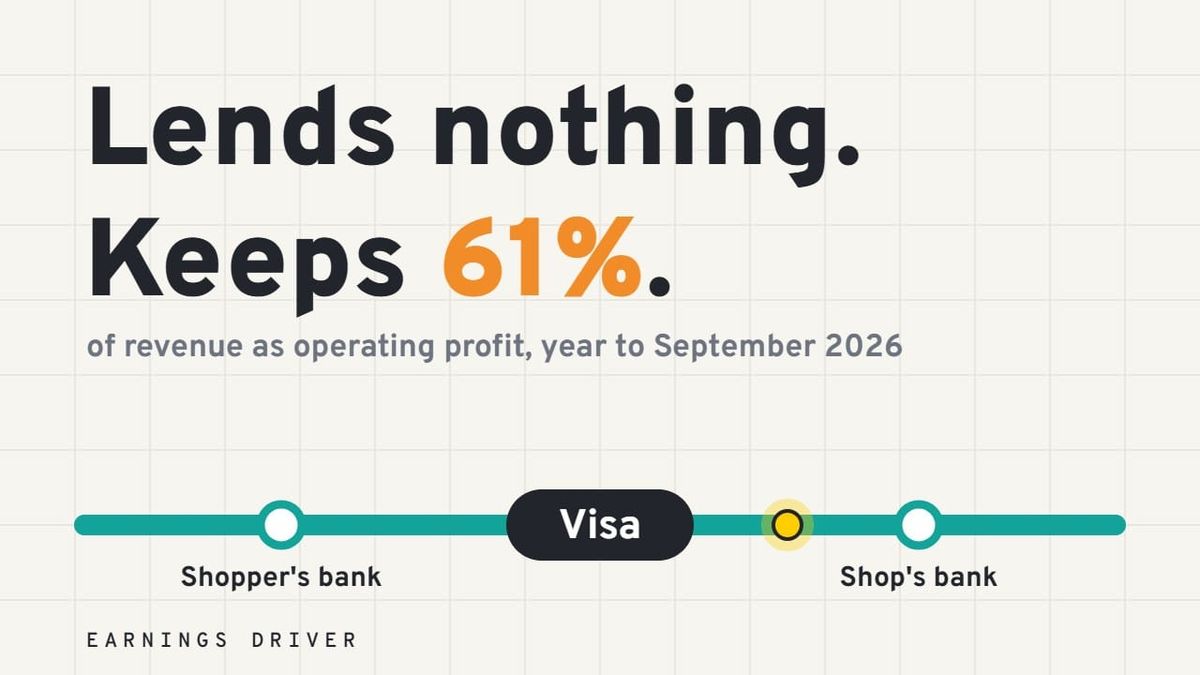
In one line: Visa earns a small fee on each payment its network carries between a shopper's bank and a shop's bank, and a growing share of its revenue from services it sells to banks and merchants. Watch whether cross-border volume grows faster than payments volume.
At a glance
- Latest: payments volume +9% and cross-border volume excluding transactions within Europe +14% in Q4 fiscal 2026 (July–September 2026), against +9% and +11% a year earlier, at constant exchange rates
- Biggest risk: court settlements and laws that cut interchange or Visa's own network fees, and payments that move between bank accounts, as in Brazil and India, without a card network
- Reports: Quarterly; fiscal year ends in September. Next results: see Earnings Dates.
On October 27, 2026, Visa reported net revenue of $45.9 billion for fiscal 2026 (October 2025–September 2026), up 15% from a year earlier. Payments on Visa cards grew 9% at constant exchange rates, and cross-border payments, where the card and the shop are in different countries, 13%. More payments explain much of that revenue. They do not explain how Visa kept $28.1 billion of it, 61%, as operating income.
What it sells vs. what it earns on
Thousands of banks issue cards with Visa's name on them. At the end of fiscal 2025, the latest year with full figures, Visa counted nearly 5 billion payment credentials. They were accepted at more than 175 million merchant locations in more than 200 countries and territories. Payments on them were $14.2 trillion in fiscal 2025 and roughly $15.6 trillion in fiscal 2026, by our calculation. Visa's network processed 281.3 billion transactions in fiscal 2026.
Visa's fiscal 2025 Form 10-K states: "Visa is not a financial institution. We do not issue cards, extend credit or set rates and fees for account holders of Visa products." Visa runs the network between the two banks in each card payment. The issuer is the bank that gave the shopper the card and, for a credit card, lends the money. The acquirer is the bank or processor that lets the shop take cards and pays the shop for each card sale.
On a $100 US credit card payment on Visa or Mastercard, merchants paid on average about $2.36 in 2025. The Merchants Payments Coalition, a US retailer group, cites the figure. Most of it, the interchange, goes to the issuer. Visa sets default interchange rates. They apply unless issuers agree other terms with acquirers or merchants. Visa does not receive interchange. Visa charges its own, much smaller network fees to the issuer and the acquirer.
Merchants have sued Visa and Mastercard over these rates. In June 2026, a US judge gave preliminary approval to a settlement of that suit; some merchant groups object. In January 2026, US senators again introduced the Credit Card Competition Act. It would require large banks' credit cards to work on at least one network other than Visa or Mastercard. Merchants could then send payments over that network.
Some payments skip card networks altogether. In Brazil and India, many shoppers pay straight from their bank accounts, through national systems called Pix and UPI.
Table 1 — Visa's revenue, fiscal 2026 (October 2025–September 2026, $ million)
| Line | Revenue | Change from fiscal 2025 | What it is charged on |
|---|---|---|---|
| Service revenue | 19,918 | +14% | Payments volume |
| Data processing revenue | 23,374 | +17% | Transactions processed |
| International transaction revenue | 15,251 | +8% | Cross-border payments and currency conversion |
| Other revenue | 5,677 | +40% | Value-added services, licensing and other |
| Client incentives | (18,317) | +16% | Paid to banks and merchants to issue and accept Visa |
| Net revenue | 45,903 | +15% |
Source: Visa fiscal Q4 2026 results release, October 27, 2026. "What it is charged on" follows Visa's descriptions of each line and our reading of them.
Cross-border payments carry the highest fees: Visa converts the currency and connects banks in two countries. Cross-border payments are also the payments that swing most with travel. The quarter to June 2020 was the first full quarter of pandemic travel restrictions. That quarter, Visa's cross-border volume excluding transactions within Europe fell 47% from a year earlier.
International transaction revenue grew 8% in fiscal 2026, slower than cross-border volume, which grew 12% excluding transactions within Europe. In the fourth quarter it grew 8% against cross-border volume growth of 14%. Chris Suh, the finance chief, said the fourth-quarter gap came "primarily" from "lower volatility levels than last year and mix." Visa earns more on currency conversion when exchange rates swing more.
What Visa earns on is a network already built. Visa does not bear the risk that a cardholder fails to repay, so it has no credit losses. Its operating expenses were $17.8 billion in fiscal 2026, mostly staff, marketing and technology. They included about $1.8 billion of pre-tax litigation provisions and $563 million of severance. Visa's operating margin was 61% as reported, or about 67.5% excluding litigation, severance and other items Visa treats as special.
What moves the profit
Operating income ≈ (Payments volume × Gross take rate) + Value-added services − Client incentives − Operating expenses
- Payments volume. The dollar value of purchases on Visa cards, excluding cash withdrawals. Visa reports its growth every quarter at constant exchange rates.
- Cross-border volume. Payments where the card and the merchant are in different countries. A higher share of cross-border volume raises the gross take rate. Visa reports its growth with and without transactions within Europe.
- Gross take rate. What Visa charges for each dollar of payments, before client incentives and excluding value-added services. Not disclosed. For scale: net revenue, after client incentives and including value-added services, was about 0.29% of payments volume in fiscal 2026, by our calculation.
- Value-added services. Fraud scoring, tokenization, analytics and other services sold to banks and merchants, much of it in other revenue. Visa gives their revenue on its earnings calls.
- Client incentives. Payments to banks and merchants to issue and accept Visa cards, subtracted from revenue.
Reading the earnings: what to watch, and how
Visa's results releases, operational data, filings and earnings calls are at investor.visa.com.
- Payments volume growth, at constant exchange rates. Read it: service revenue follows payments volume. Slower growth while inflation holds steady points to weaker spending on Visa cards. Latest: +9% in Q4 fiscal 2026 (July–September 2026), against +9% a year earlier. US payments volume grew 10%, and Visa said it was still up 10% through October 21.
- Cross-border volume growth, excluding within Europe. Read it: cross-border payments carry Visa's highest fees, so growth faster than payments volume raises the gross take rate. Lower currency volatility and mix can offset that, as Visa said they did in Q4 fiscal 2026. Slower cross-border growth usually shows weaker travel. Latest: +14% in Q4 fiscal 2026, against +11% a year earlier.
- Value-added services growth. Read it: Visa gives this figure on its earnings calls, not in its results release. Latest: $4 billion in Q4 fiscal 2026, up 31% at constant exchange rates.
- Client incentives against gross revenue. Read it: client incentives rising faster than gross revenue (revenue before client incentives) means Visa is paying more to win and keep bank partners. Latest: client incentives +21% in Q4 fiscal 2026, against +15% for gross revenue before incentives (our calculation).
Leading indicators (outside Visa's filings)
- US card spending. Card spending moves Visa's US payments volume, which Visa reports weeks later. (demand)
- When: monthly, around the 10th. Where: Bank of America Institute, Consumer Checkpoint.
- Latest: card spending per household rose 6.2% from a year earlier in September 2026, or 5.1% excluding gas.
- US retail sales. A broader read on what shoppers spend, by card or otherwise. (demand)
- When: monthly, mid-month. Where: US Census Bureau, advance monthly retail sales.
- Latest: $745.0 billion in September 2026, up 6.3% from a year earlier; sales at nonstore retailers rose 8.2%.
- International travel to and from the US. Travel drives cross-border volume. These figures cover US travel only; Visa's cross-border volume is global. (cross-border)
- When: monthly, about six weeks after the month ends. Where: US National Travel and Tourism Office.
- Latest: in August 2026, overseas visitors to the US fell 11.8% from a year earlier; spending by all international visitors fell about 5%; Americans' spending abroad rose 0.5%.
What Wall Street is asking
Across Visa's last four earnings calls, from January to October 2026, analysts kept returning to a few questions.
- "Will cross-border volume keep growing faster than payments volume?" In October, Suh said Visa's fiscal 2027 outlook assumes "stable drivers" for cross-border volume. Cross-border volume excluding transactions within Europe was up 15% in the first three weeks of October, he said.
- "When will payments made by AI agents add to Visa's results?" In October, Visa said nearly 50 AI partners were "live and in production," a number it expects to "double in the coming months." Ryan McInerney, the chief executive, said that over the next four quarters, "it all remains very small in the big scheme."
- "Can value-added services keep growing about three times as fast as payments?" In October, McInerney said the business "grew revenue 30% in constant dollars to $14 billion" in fiscal 2026, and that Visa expects growth "in the low to mid-20s in 2027."
- "How fast will operating expenses grow against net revenue?" In October, Suh said Visa expects "to grow adjusted operating expense in the low double digits, modestly below net revenue growth" in fiscal 2027.
- "How much will client incentives rise as more bank contracts come up for renewal?" In October, Suh said about 25% of Visa's payments volume will be renewed in fiscal 2027, "versus the 20%" in fiscal 2026. He said this "implies a step-up in the year-over-year growth rate" of incentives.
A note on valuation
On October 26, 2026, the day before its results, Visa's shares closed at $404.16, about 33 times the $12.32 a share it earned in fiscal 2026. At the end of each calendar year from 2021 to 2025, the share price was between about 28 and 35 times the previous four quarters' earnings. The litigation provisions lowered fiscal 2026 earnings by about $0.70 a share.
The bottom line
Visa carries payments without lending, so it has no loans to go bad and keeps much of its revenue as profit. In fiscal 2026, cross-border payments, its highest-fee payments, grew fastest. The open question is how much more Visa pays banks, and whether courts and new laws cut card fees. (See: Nvidia Sells Chips. It Earns on Being Hard to Leave.)
What changes when the card company lends the money itself? The book's chapter on Visa and American Express compares a network that carries the payment with one that also funds it and carries the risk of default: Earnings Driver.
Sources: Visa fiscal Q4 and full-year 2026 results release (Form 8-K, October 27, 2026); Visa fiscal Q4 2025 results (October 28, 2025) and Form 10-K for fiscal 2025; Visa earnings calls of January 29, April 28, July 28 and October 27, 2026; Visa fiscal Q3 2020 results (July 2020); Merchants Payments Coalition (2026, on 2025 fees); Bank of America Institute, Consumer Checkpoint (October 2026); US Census Bureau advance retail sales (October 15, 2026); US National Travel and Tourism Office (August 2026 data); Credit Card Competition Act of 2026 (S. 3623, January 13, 2026); court filings and reports on the merchant interchange settlement (preliminary approval June 9, 2026); share price as of October 26, 2026 (Yahoo Finance, MarketScreener); year-end price-to-earnings ratios for 2021–2025 (CompaniesMarketCap).
For sources that work for any company — filings, earnings calendars, consensus estimates — see Where to find the numbers.
Educational only, not investment advice. Figures as of the periods noted.