Nvidia Sells Chips. It Earns on Being Hard to Leave.
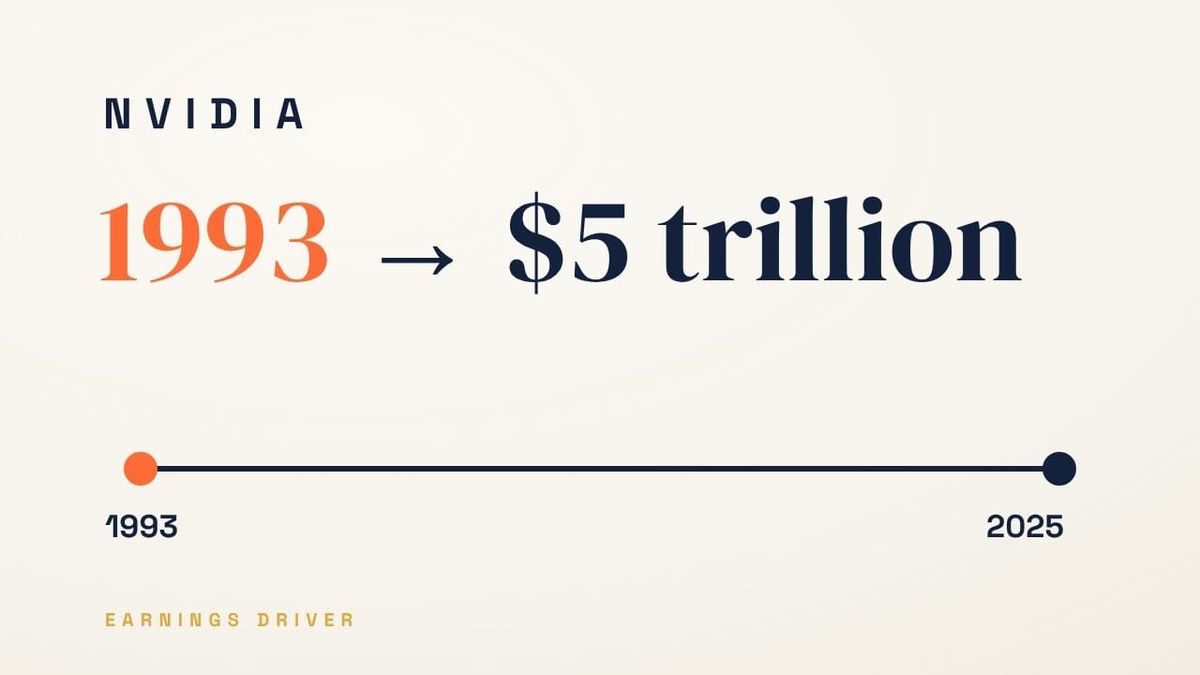
Nvidia sells chips, but it earns on CUDA, the software that makes its chips hard to leave. Watch whether the gross margin holds once chip supply meets demand.
Latest results: What Nvidia's 3Q (Aug–Oct 2026) results showed
In one line: Nvidia sells chips, but it earns on CUDA, the software that makes its chips hard to leave. Watch whether the gross margin holds once chip supply meets demand.
At a glance
- Latest: GAAP gross margin 75.0% in Q2 FY2027 (May–July 2026), up from 72.4% a year earlier
- Biggest risk: the largest customers building their own chips, especially for inference (running trained models for users)
- Reports: Quarterly; the fiscal year ends in late January. Next results: see Earnings Dates.
On August 26, 2026, Nvidia reported revenue of $96.2 billion for Q2 FY2027 (May–July 2026), up 106% from a year earlier. Data-center revenue of $89 billion makes up most of that revenue, but it does not explain the gross margin of 75%, a level companies that sell hardware rarely reach.
What it sells vs. what it earns on
Nvidia calls the largest cloud and consumer-internet companies hyperscalers. Edge computing covers PCs, gaming, workstations, robots and cars.
Table 1 — Nvidia's revenue by buyer, Q2 FY2027 (May–July 2026)
| Buyers | Revenue | Share |
|---|---|---|
| Hyperscalers | $48.7B | 51% |
| AI clouds, industrial, enterprise | $40.3B | 42% |
| Edge computing | $7.2B | 7% |
| Total | $96.2B | 100% |
Nvidia owns no chip factory. TSMC in Taiwan builds most of Nvidia's chips. Nvidia keeps the design, the software and the customer relationships, which makes it a fabless designer.
A rival can copy a chip, or even build a faster one. What a rival cannot copy cheaply is CUDA, the software Nvidia has built over nearly two decades. Nvidia's customers have written years of code for CUDA. Over 7.5 million developers use CUDA and Nvidia's other tools (10-K for FY2026, February 2025–January 2026). A customer that switches to a rival's chip must rewrite code, retrain engineers and abandon years of tools. That switching cost lets Nvidia hold its price while rivals compete on specs.
What moves the profit
Operating income ≈ chips sold × (price per chip − build cost per chip) − R&D − marketing and overhead
Price per chip, chips sold and build cost per chip are not disclosed. Price and chips sold show up in data-center revenue. Price and build cost show up in the gross margin.
- Price per chip. The premium for the design and the software, protected by the CUDA switching cost and by scarce supply.
- Chips sold. Large, but limited by how many chips Nvidia's suppliers can build, package and supply with memory. Nvidia expects supply to remain the limit at least through fiscal 2028 (February 2027–January 2028).
- Build cost per chip. The foundry (mainly TSMC), the memory and the packaging. Build cost is Nvidia's largest cost.
- R&D. Spending on new chip designs and the software around them, to keep each generation ahead of rivals.
Reading the earnings: what to watch, and how
Nvidia's results release, 10-Q/10-K and earnings call are all at investor.nvidia.com.
- Data-center revenue and its growth from the prior quarter. Read it: slowing growth is the first warning sign, long before annual growth looks weak. Slowing growth can mean weaker demand, new limits on sales to China, or supply that cannot keep up. Latest: $89.0 billion in Q2 FY2027 (May–July 2026), up 18% from the prior quarter (21% in Q1 FY2027, February–April 2026) and 117% from a year earlier.
- Gross margin and next quarter's margin guidance. Read it: a margin in the low-to-mid 70s while memory and other build costs rise means pricing power is intact. Scarce supply supports the margin while it lasts, so the real test of CUDA is whether the margin holds once supply meets demand. Latest: 75.0% in Q2 FY2027, up from 72.4% a year earlier. Q3 FY2027 (August–October 2026) is guided to 74.0% ± 0.5 percentage point.
- Next-quarter revenue guidance. Read it: the stock moves more on this forecast, against analysts' expectations, than on the quarter just reported. Latest: Q3 FY2027 guidance, which assumes no data-center compute revenue from China, is $108.0 billion ± 2%, against $96.2 billion in Q2 FY2027.
- Supply commitments and inventory (balance-sheet notes). Read it: rising commitments mean Nvidia expects demand to last, though part of a rise can come from higher memory prices. Inventory rising while revenue growth slows means chips are not selling as fast as Nvidia planned. Latest: inventory was $31.6 billion on July 26, 2026, up from $25.8 billion a quarter earlier. Supply commitments rose to $279 billion from $119 billion a quarter earlier, mainly for memory.
- Customer concentration (10-Q/10-K). Read it: a few buyers making up a large share of sales and accounts receivable is a risk to Nvidia's price. The risk grows when the cloud companies behind those purchases also build their own chips. Latest: on July 26, 2026, five direct customers accounted for 70% of Nvidia's accounts receivable, the money customers owed it (22%, 14%, 13%, 11% and 10%).
Leading indicators (outside Nvidia's filings)
- Hyperscaler capital spending. Microsoft, Alphabet, Amazon and Meta spend heavily on AI data centers. Much of that spending becomes Nvidia's revenue, though part of it goes to the hyperscalers' own chips, such as Amazon's Trainium. Their results and spending guidance come out a few weeks before Nvidia's results. (demand)
- When: quarterly, with each company's earnings (late January or early February, April, July and October). Where: each company's results release (the capital spending line in the cash-flow statement) and call (spending guidance). Microsoft and Amazon report finance leases separately.
- Latest: about $172 billion combined in April–June 2026, including finance leases, up about 77% from a year earlier (a tally by Platformonomics, an independent technology newsletter).
- HBM memory makers. SK hynix, Micron and Samsung make the high-bandwidth memory (HBM) packaged with each Nvidia AI chip. How tight HBM supply is, and how fast the makers add capacity, limit how many chips Nvidia can ship. (supply)
- When: quarterly earnings, plus capacity and pricing comments between them. Where: the makers' earnings calls and memory-market trackers (e.g., TrendForce).
- Latest: on September 30, 2026, Micron said agreements covered most of its 2027 HBM supply.
- TSMC's advanced-packaging (CoWoS) capacity. CoWoS capacity limits how many AI chips can ship. (supply)
- When: quarterly earnings and capital spending guidance. Where: TSMC's quarterly call and IR site.
- Latest: on July 16, 2026, TSMC said its packaging capacity was so tight that it was limiting customers' growth.
- GPU cloud rental prices. Rental prices for AI chips move week to week with demand and with the arrival of newer chips. Falling prices for the same chip can show weakening demand before Nvidia reports. (demand)
- When: continuous. Where: GPU cloud providers' pricing pages (the big clouds, plus specialists like CoreWeave and Lambda) and GPU price indexes.
- Latest: the median on-demand rental price of an H100, Nvidia's Hopper-generation chip, was $3.44 an hour in the week of October 5, 2026, up 15% from a year earlier (getdeploying.com index).
- Power and data-center availability. Grid connections and the pace of data-center construction limit how fast chips can be installed and used. (deployment)
- When: quarterly and slower. Where: earnings of data-center landlords (Equinix, Digital Realty), grid operators' connection-queue data and industry research.
- Latest: in Q2 2026, Digital Realty reported a record backlog of signed leases that had not yet started, worth $1.9 billion a year in rent, including its joint-venture partners' share.
What analysts are asking
Across Nvidia's last four earnings calls, from November 2025 to August 2026, analysts kept returning to a few questions.
- "Is the number of chips Nvidia sells limited by demand or by supply?" In August, Nvidia forecast revenue growth of about 70% for fiscal 2028 (February 2027–January 2028). Jensen Huang, Nvidia's chief executive, said, "even though our demand is much greater than 70%, our supply allows us to confidently deliver 70%."
- "Can Nvidia keep its share of inference as customers build their own chips?" In May, Huang said, "we are growing share in inference." In August, he said many customer-designed chips "are inference-specific chips for one cloud or one service," while Nvidia sells a platform "that you can use in any cloud."
- "Can customers keep raising their data-center spending, and so keep buying more Nvidia chips?" In May, Huang said Nvidia "should be growing faster than hyperscale CapEx," the hyperscalers' capital spending. He also expected sales to AI clouds, industrial companies and other enterprises to grow faster than sales to the hyperscalers. In August, Colette Kress, the chief financial officer, said capital spending by the five largest hyperscalers "is expected to reach nearly $800 billion in 2026 and $1.3 trillion in 2027."
- "How much revenue can each gigawatt of data-center power bring Nvidia?" Customers plan data centers by the electric power they can secure, measured in gigawatts. Hopper and Grace Blackwell are Nvidia's two latest chip generations, and Vera Rubin is the next one. In August, Huang put Nvidia's revenue opportunity per gigawatt at $18 billion for Hopper, $25 billion for Grace Blackwell and $40 billion for Vera Rubin.
- "Can the gross margin hold as memory costs rise?" In August, Kress said she expects the margin to settle "at 72% to 73% in fiscal year 2028 as executed price increases take effect in Q1," meaning February–April 2027.
A note on valuation
In Q2 FY2027 (May–July 2026), gains on stakes in other companies lifted Nvidia's GAAP earnings per share to $2.46, against $2.22 on Nvidia's non-GAAP measure.
The bottom line
Customers stay with Nvidia, and Nvidia holds its price, because years of their code are written for CUDA. Scarce supply also props up its gross margin, even as memory costs rise. The test is whether the margin holds once supply meets demand and customers use more of their own chips. (See: TSMC Builds Other People's Chips. It Earns on Being Almost Impossible to Replace.)
Why do customers keep paying Nvidia's price when a rival can build a faster chip? The book explains how switching costs let a company hold its price, across many industries: Earnings Driver.
Sources: Nvidia Q2 FY2027 results (quarter ended July 26, 2026, reported August 26, 2026) and Form 10-Q; Nvidia FY2026 Form 10-K (CUDA developers); Q2 FY2027 CFO commentary (market platforms) and Q1 FY2027 CFO commentary (what edge computing includes); Nvidia earnings calls of November 19, 2025, and February 25, May 20 and August 26, 2026. All at investor.nvidia.com. Leading indicators: Microsoft, Alphabet, Amazon and Meta Q2 2026 results (July 2026); Amazon Q1 2026 results (April 29, 2026, Trainium) and Platformonomics capex tally (July 2026); Micron fiscal Q4 2026 call (September 30, 2026); TSMC Q2 2026 call (July 16, 2026); getdeploying.com GPU price index (October 2026); Digital Realty Q2 2026 results (July 23, 2026).
For sources that work for any company — filings, earnings calendars, consensus estimates — see Where to find the numbers.
Educational only, not investment advice. Figures as of the periods noted.