Palantir Sells Data Software. Most of Its Added Revenue Becomes Profit.
Palantir earns by selling software contracts of one to five years to governments and companies, and it keeps most of its added revenue as operating income. Watch whether existing customers keep spending more, and whether the value of contracts signed each quarter keeps up with revenue.
In one line: Palantir earns by selling software contracts of one to five years to governments and companies, and it keeps most of its added revenue as operating income. Watch whether existing customers keep spending more, and whether the value of contracts signed each quarter keeps up with revenue.
At a glance
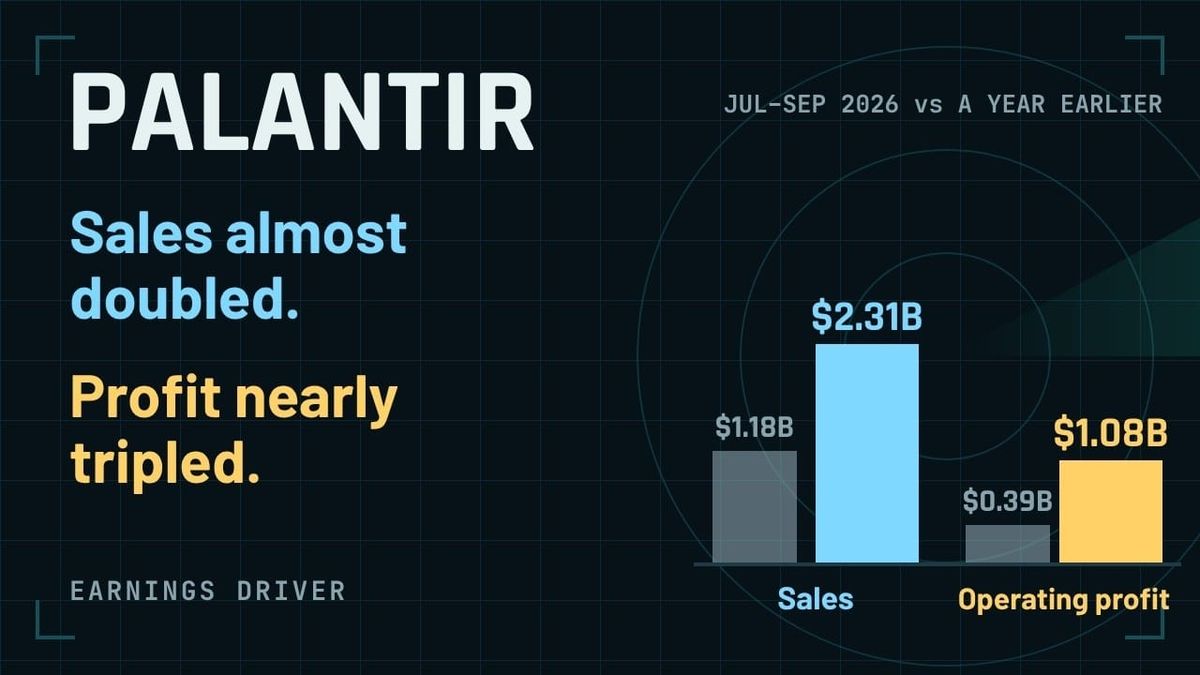
- Latest: Palantir's revenue was $2.31 billion in 3Q (Jul–Sep 2026), up 96% from a year earlier. GAAP operating income was $1.08 billion, or 47% of revenue, up from 33% a year earlier.
- Biggest risk: The total value of contracts signed in 3Q (Jul–Sep 2026) rose 6% from a year earlier, far below revenue growth. Palantir said several large contracts were shorter than usual, and many customers can end contracts early.
- Reports: Quarterly. Next results: see Earnings Dates.
On November 2, 2026, Palantir reported revenue above $2 billion in a quarter for the first time. Revenue for 3Q (Jul–Sep 2026) rose 96% from a year earlier to $2.31 billion. Operating income rose from $393 million to $1.08 billion. For the first time, US companies paid Palantir more than the US government did.
Who Palantir is
Palantir was founded in 2003. It first built software for US intelligence agencies, then began selling to companies as well. Its shares started trading on the New York Stock Exchange in September 2020 through a direct listing, and moved to Nasdaq in 2024. In 2023, it began selling AIP (Artificial Intelligence Platform), which connects AI models to a customer's own data and daily work.
Palantir's software pulls data from many systems into one place, so that people can see it together and act on it. Palantir's main products are Gotham, built for defense and intelligence work, and Foundry, which companies and governments use to run their operations. AIP runs on top of both. Customers include armed forces and government agencies, and companies such as manufacturers, insurers and hospital groups.
Palantir counts as a customer any organization it earned revenue from over the past 12 months. It had 1,090 customers in the 12 months to September 2026, up from 911 a year earlier. Its top 20 customers paid an average of $146 million each over those 12 months, against $83 million a year earlier. In 2025, the top three customers together brought in 16% of Palantir's revenue.
The latest quarter against expectations
Table 1 — Palantir's results and guidance against analysts' estimates
| Palantir | Analysts' estimates | Compared with estimates | |
|---|---|---|---|
| Revenue, 3Q (Jul–Sep 2026) | $2.31 billion | $2.17–2.18 billion | About 6–7% above |
| Adjusted EPS, 3Q (Jul–Sep 2026) | $0.44 | $0.40–0.41 | About 7–10% above |
| Revenue guidance, 4Q (Oct–Dec 2026) | $2.649–2.653 billion | $2.45–2.46 billion | About 8% above at the midpoint |
Estimates are consensus estimates published before the results. Adjusted EPS leaves out share-based pay and related payroll taxes, and applies an estimated 23% long-term tax rate to the adjustments (non-GAAP).
In 3Q (Jul–Sep 2026), US commercial revenue rose 29% from the previous quarter, faster than Palantir's other revenue.
Palantir raised its 2026 revenue guidance to $8.530–8.534 billion, from $8.150–8.158 billion in August. The middle of the guidance for 4Q (Oct–Dec 2026) is about 15% above revenue in 3Q (Jul–Sep 2026). Revenue in 3Q (Jul–Sep 2026) had risen 20% from the previous quarter.
What it sells vs. what it earns on
Palantir sells its software in three forms: subscriptions to software it runs in the cloud, licenses with support for software that customers run themselves, and services that help customers use it. Palantir credits growth from existing customers to wider use of its products.
Customers often begin with a short trial, such as a workshop Palantir calls a bootcamp, generally at Palantir's expense. A sale often takes six to nine months, and sometimes a year or more. Contracts run one to five years, and many customers can end them early.
Table 2 — Palantir's revenue by customer type
| Customer type | 3Q (Jul–Sep 2026) | 3Q (Jul–Sep 2025) | Change |
|---|---|---|---|
| US companies (US commercial) | $984 million | $397 million | +148% |
| US government | $953 million | $486 million | +96% |
| Companies outside the US | $184 million | $152 million | +21% |
| Governments outside the US | $192 million | $147 million | +31% |
| Total | $2,313 million | $1,181 million | +96% |
Palantir gave the two international figures on its earnings calls. Figures may not add because of rounding.
Revenue grew $1.13 billion from a year earlier, and US companies and the US government brought in 93% of that rise. Cost of revenue rose $176 million and operating expenses rose $265 million, leaving $692 million more operating income. In other words, 61% of the added revenue became operating income, which lifted the operating margin from 33% to 47%.
Cost of revenue is mainly the pay of staff who set up and run the software for customers, plus cloud hosting. Palantir said third-party cloud hosting accounted for $135 million of the rise in cost of revenue. Gross margin was 83% in 3Q (Jul–Sep 2026), against 82% a year earlier.
What moves the profit
Operating income ≈ Customers × Revenue per customer − Cost of revenue (staff and cloud hosting) − Sales and marketing − Research and development and administration
- Customers: Reported every quarter, counted over the past 12 months, with a separate count of US commercial customers.
- Revenue per customer: Not disclosed for all customers. Palantir reports the average for its top 20 customers and net dollar retention.
- Share-based pay: $319 million in 3Q (Jul–Sep 2026), or 14% of revenue, spread across cost of revenue and operating expenses.
Reading the earnings: what to watch, and how
Palantir's results release, investor presentation, 10-Q and 10-K are at investors.palantir.com.
- US commercial revenue and US commercial customers
Read it: If revenue grows faster than the number of customers, the average customer is paying more.
Latest: US commercial revenue was $984 million in 3Q (Jul–Sep 2026), up 148% from a year earlier. Palantir counted 686 US commercial customers, up 29% from a year earlier and 5% from the previous quarter. - Net dollar retention
Read it: A fall over several quarters shows existing customers adding less, even while revenue still grows.
Latest: 165% in 3Q (Jul–Sep 2026), up from 157% in the previous quarter and 139% in 4Q (Oct–Dec 2025). - Total contract value against revenue
Read it: Total contract value (TCV) is the potential lifetime value of the contracts signed in a quarter, counted at signing. TCV also falls when contracts are shorter, so read it with what Palantir says about contract length.
Latest: TCV was $2.918 billion in 3Q (Jul–Sep 2026), up 6% from a year earlier and down from $3.373 billion in the previous quarter. Chief financial officer David Glazer said several contracts worth tens of millions of dollars were shorter than usual, and he expects such contracts to grow longer and larger over time. - US government revenue
Read it: Government revenue can jump with a few large awards, so judge it over several quarters.
Latest: $953 million in 3Q (Jul–Sep 2026), up 96% from a year earlier, which Palantir credited to existing programs and new awards. - GAAP and adjusted operating margin
Read it: The gap between the two is mainly share-based pay, which costs shareholders through new shares rather than cash.
Latest: GAAP operating margin was 47% in 3Q (Jul–Sep 2026) and adjusted operating margin was 62%, a gap of 15 percentage points, down from 18 points a year earlier (33% and 51%).
Leading indicators (outside Palantir's filings)
- US defense contract announcements (demand, US government)
- When: Each business day
- Where: defense.gov (Contracts) and US Army press releases
- Latest: On September 1, 2026, the US Army ordered eight TITAN systems, which help soldiers find targets: $127 million to Palantir and $65 million to Anduril for the hardware.
What analysts are asking
Palantir's earnings calls take only a few questions from analysts. Here are five of them from its last four calls, from February to November 2026, summarized in our words.
- "Do customers become tied to one AI model maker's models?" In August 2026, chief revenue officer Ryan Taylor said customers do not need to depend on one model. Chief executive Alex Karp said Palantir's software lets customers switch the models they use.
- "Is Palantir growing by adding customers or by selling more to each one?" In February 2026, Karp said revenue would grow much faster than the number of customers. He said customers serious about AI were giving Palantir many of their most important problems.
- "How do bootcamps turn prospects into customers?" In November 2026, Karp said customers move from first contact to a deal much faster than before, with first deals of about $25 million instead of about $250,000. He said Palantir has to shift its staff to focus on those customers.
- "Can Palantir hire enough engineers?" In May 2026, Karp said he was taking part in hiring himself. He said he was confident Palantir would keep attracting and keeping strong engineers.
- "How much of government growth depends on the US defense budget?" In May 2026, chief technology officer Shyam Sankar said the Defense Department was moving as much spending as it could into 2026. Based on past years, he expected Congress to fund the government through a continuing resolution, which keeps spending at the previous year's level.
A note on valuation
Palantir's share price closed at $178.34 on November 2, 2026, before the results. That was a price-to-earnings ratio of about 125 on GAAP earnings per share of $1.43 for the four quarters to September 2026.
The bottom line
In 3Q (Jul–Sep 2026), Palantir's revenue rose faster than its costs, led by US companies and the US government. Customers who were with Palantir a year earlier paid far more than before. What is not yet known is whether new contracts will grow fast enough to keep revenue rising this quickly.
How does a defense contractor like Lockheed Martin set its profit, and why are software companies such as Palantir challenging that model? In Earnings Driver, the chapter on defense explains how cost-plus contracts set a prime contractor's profit, and how software-first companies such as Palantir are challenging that model.
Sources: Palantir Technologies, 3Q (Jul–Sep 2026) results release (Form 8-K, November 2, 2026) and Form 10-Q for the quarter ended September 30, 2026; Palantir results releases for 4Q (Oct–Dec 2025), 1Q (Jan–Mar 2026) and 2Q (Apr–Jun 2026), published February 2, May 4 and August 3, 2026; earnings call transcripts for February 2, May 4, August 3 and November 2, 2026; Earnings Whispers, LSEG (via TechNews) and FactSet (via SiliconANGLE) (estimates before the results); Nasdaq.com and Gotrade (share price, November 2–3, 2026); US Army announcement (September 1, 2026, via DefenseScoop).
For sources that work for any company — filings, earnings calendars, consensus estimates — see Where to find the numbers.
Educational only, not investment advice. Figures as of the periods noted.