Ibiden Makes the Boards AI Chips Sit On. A Shortage of Them Lifts Its Margin.
Ibiden earns most of its operating income from substrates, the small boards that connect a chip to the rest of a server, and buyers want those for AI chips faster than the industry can make them. Watch whether its electronics operating margin holds near 29% as rivals add capacity.
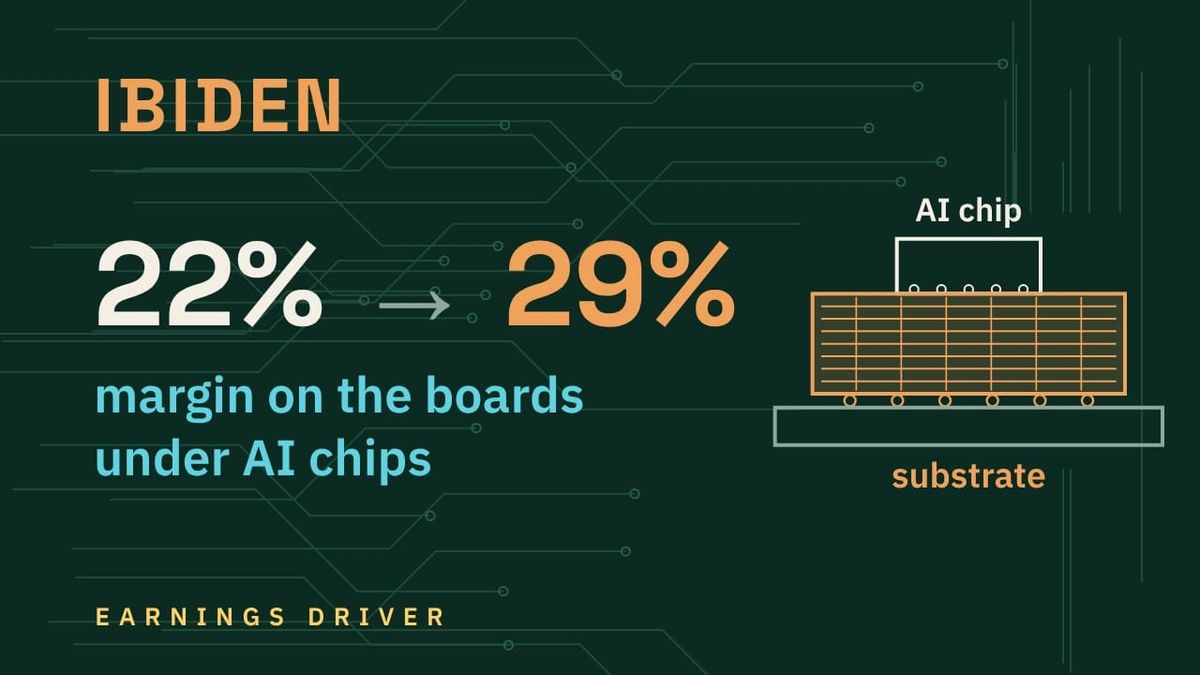
In one line: Ibiden earns most of its operating income from substrates, the small boards that connect a chip to the rest of a server, and buyers want those for AI chips faster than the industry can make them. Watch whether its electronics operating margin holds near 29% as rivals add capacity.
At a glance
- Latest: in April–September 2026, the electronics business earned an operating margin of 29.0%, up from 22.4% a year earlier. Ibiden expects about 30% in October 2026–March 2027, even though it assumes a stronger yen.
- Biggest risk: if rivals' capacity for the most advanced AI substrates catches up with demand, average substrate prices could stop rising. Ibiden says that capacity, added together, still falls short. Two customers, Nvidia and Intel, bought nearly half of what Ibiden sold in the year to March 2026.
- Reports: Quarterly. Ibiden's fiscal year runs from April to March. Next results: see Earnings Dates.
On October 29, 2026, Ibiden reported revenue of ¥262.5 billion (about US$1.65 billion) for April–September 2026, 34% more than a year earlier. Operating income rose 85% to ¥60.1 billion (about US$377 million).
Who Ibiden is
Ibiden began in 1912 in Ogaki, in central Japan, as Ibigawa Electric Power. It built hydroelectric plants on the Ibi River and sold the power. From 1917, it used its electricity to make carbide, a chemical that takes a great deal of power to produce.
Ibiden later made carbon products, ceramics and, from the 1970s, circuit boards. It took the name Ibiden in 1982 and began making substrates for chip packages in 1987. Ibiden says it was the first company to put a diesel particulate filter, which traps soot in car exhaust, into use in passenger cars, in 1999.
Today, Ibiden's electronics business makes substrates for the chips in servers and PCs. A substrate is a small board with many thin layers of wiring. The chip sits on top of it, and the substrate connects the chip's tiny contacts to the larger circuit board of a server. The ceramics business makes diesel particulate filters, other parts for car exhaust systems, and graphite products. Ibiden's plants are mainly in Gifu Prefecture, Japan, with others in countries including the Philippines, Malaysia, Hungary and Mexico.
Intel was Ibiden's largest customer in the year to March 2025, with 21% of revenue, and Nvidia had 20%. In the year to March 2026, Nvidia had 29% and Intel 18%.
The latest quarter against expectations
Table 1 — Ibiden's results and guidance against analysts' estimates
| Ibiden | Analysts' estimates | Compared with estimates | |
|---|---|---|---|
| Revenue, July–September 2026 | ¥139.3B | About ¥131.9B | About 6% above |
| Operating income, July–September 2026 | ¥33.2B | About ¥30.2B | About 10% above |
| Operating income guidance, April 2026–March 2027 | ¥133.0B | ¥128.0B | About 4% above |
Analysts' estimates are consensus estimates made before Ibiden reported, from Investing.com. The July–September estimates are worked out from how far above them Investing.com said the results were. Ibiden gives guidance for its full fiscal year, not for the next quarter. July–September figures are April–September minus April–June. Sources: Ibiden's results release for April–September 2026; Investing.com.
Net income for July–September was about 2% below estimates, because, Investing.com said, Ibiden's tax rate was higher than analysts assumed.
Ibiden raised its operating income guidance for April 2026–March 2027 to ¥133.0 billion, from ¥127.0 billion in August and ¥90.0 billion in May. The new figure is about 4% above estimates. It assumes ¥150 to the dollar in October 2026–March 2027, a stronger yen than the ¥159 of April–September.
What it sells vs. what it earns on
The electronics business brought in 66% of Ibiden's revenue in April–September 2026 but earned 83% of its operating income. Its operating margin was 29.0%, against 11.7% for ceramics.
Table 2 — Ibiden's revenue and operating income by segment, April–September 2026
| Electronics | Ceramics | Other | Ibiden | |
|---|---|---|---|---|
| Revenue | ¥172.5B | ¥46.2B | ¥43.8B | ¥262.5B |
| Change from a year earlier | +52% | +16% | +4% | +34% |
| Operating income | ¥50.0B | ¥5.4B | ¥4.6B | ¥60.1B |
| Operating margin | 29.0% | 11.7% | 10.5% | 22.9% |
| Operating margin a year earlier | 22.4% | 9.7% | 7.7% | 16.7% |
Operating income for Ibiden includes ¥0.1 billion of adjustments between segments. Other includes construction, building materials and plastics processing. At the average exchange rate for April–September 2026 of about ¥159 to the dollar, ¥172.5 billion is about US$1.08 billion. Source: Ibiden's results release for April–September 2026.
Electronics revenue grew 52% from a year earlier. Ibiden said demand for substrates for AI servers and ordinary servers was generally firm. It also named steady output at its new plant in Ono, which began mass production in 2025, and a weaker yen as reasons for the growth. Ibiden's average exchange rate was ¥159 to the dollar in April–September 2026, against ¥145 a year earlier. A weaker yen raises the yen value of sales made in dollars. Ibiden did not say how much of the growth came from currency.
In August, Ibiden named prices as the main reason it raised its electronics profit forecast. It said it was finding it easier to keep its prices in quarterly talks with customers, and that a shortage across the industry had raised the average price of substrates more than it expected. Chips for AI servers also keep getting larger. The substrates under them must be larger and have more layers of wiring, which Ibiden says adds value.
The electronics margin has swung widely from quarter to quarter. It was 4.1% in October–December 2024 and 30.2% in July–September 2026.
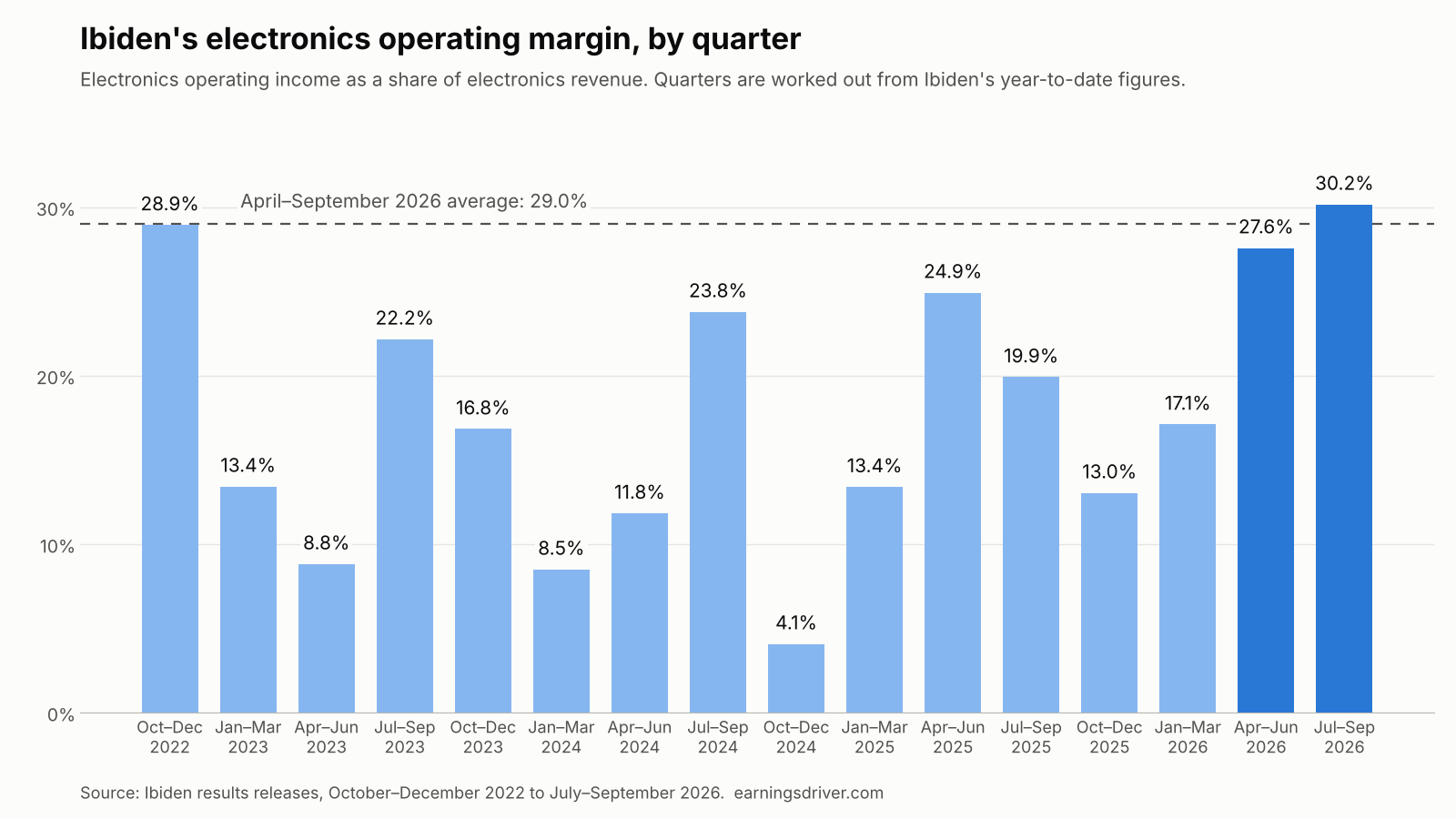
Chart 1 — Ibiden's electronics operating margin, by quarter. Ibiden reports segment figures from the start of its fiscal year, so each quarter is the year-to-date figure minus the one before. Source: Ibiden's results releases.
Few companies can make the most advanced substrates. In February 2026, Ibiden put its share of substrates for AI servers at about 70–80%. In May, it said its share of substrates for a new generation of AI chips starts close to 100% and falls by about 20–30% after three to six months.
On October 21, Nvidia said its substrate suppliers include Ibiden, Unimicron of Taiwan and Samsung Electro-Mechanics of South Korea, which was joining for the first time. On October 30, Ibiden said its rivals' capacity for the most advanced AI substrates, added together, still falls short of demand.
Ibiden's ceramics revenue grew 16%. Ibiden said a temporary rise in orders for diesel particulate filters and the weaker yen added to it. It expects ceramics operating income to fall to about ¥2.1 billion in October 2026–March 2027, from ¥5.4 billion in April–September. It did not give a reason.
What moves the profit
Operating income ≈ Substrates sold × Average price per substrate − Cost of making them − Depreciation on plants + Ceramics and other operating income − Overhead
- Substrates sold. Not disclosed. Ibiden reports electronics revenue each quarter. It also shows, in charts, how its electronics revenue splits between AI servers, ordinary servers, network switches, and PCs and other uses, without numbers.
- Average price per substrate. Not disclosed. In August 2026, Ibiden raised its electronics operating income forecast for the year to March 2027 by ¥35.0 billion from its May forecast. It said ¥26.5 billion of that came from higher prices and a better mix of products, ¥3.0 billion from more units, ¥2.0 billion from the yen and ¥3.5 billion from higher productivity.
- Cost of making them. Materials and other production costs, apart from depreciation. Not disclosed for electronics on its own; it shows in the electronics operating margin. Ibiden said in August that it passes higher prices of its main materials on to customers.
- Depreciation on plants. Ibiden expects depreciation of ¥81.0 billion in the year to March 2027, and ¥90.0 billion the year after. It plans ¥210.0 billion (about US$1.36 billion, at Ibiden's assumed ¥154 to the dollar for the year) of capital spending in the year to March 2027, ¥200.0 billion of it in electronics. Ibiden said a new plant building takes at least four years from the decision to build it.
- Who pays for new plants. Ibiden said that under its contracts, customers cover an amount equal to the cost of new capacity, partly by paying in advance. On October 21, Nvidia said it is paying Ibiden a multibillion-dollar advance to reserve capacity at the Ono plant, which is set to triple, with the added capacity starting in early 2028. On September 30, 2026, before Nvidia's announcement, advance payments from all customers stood at ¥199.7 billion (about US$1.27 billion), up from ¥81.0 billion (about US$0.51 billion) on March 31.
Reading the earnings: what to watch, and how
Ibiden's results releases, presentations and summaries of analysts' questions are on its Japanese investor site, ibiden.co.jp.
- The electronics operating margin, against Ibiden's forecast.
Read it: the margin swings widely from quarter to quarter, and in each of the last three years it fell from July–September to October–December (Chart 1). Ibiden expects about 30% for October 2026–March 2027, so a lower margin across that half, rather than in one quarter, would suggest that prices have stopped rising or that the cost of new plants is arriving before the revenue from them.
Latest: 29.0% in April–September 2026: 27.6% in April–June and 30.2% in July–September. Ibiden's forecast assumes ¥150 to the dollar. - Electronics revenue.
Read it: while demand is larger than what the industry can supply, growth mostly shows how much more Ibiden can make and sell, and slower growth as its plants add capacity may mean demand is weakening. Check how much the yen moved in the same months.
Latest: ¥172.5 billion in April–September 2026, up 52% from a year earlier. Ibiden expects ¥212.5 billion in October 2026–March 2027. - Advance payments from customers.
Read it: a rising balance means customers are still paying ahead to secure future supply. A falling balance can mean that Ibiden is delivering the substrates already paid for, so read it with Ibiden's announcements of new plants.
Latest: ¥199.7 billion on September 30, 2026, up from ¥81.0 billion on March 31, 2026. - The ceramics operating income.
Read it: Ibiden expects ceramics operating income to fall by more than half in October 2026–March 2027 and has not said why. A smaller fall than expected would offset part of any shortfall in electronics.
Latest: ¥5.4 billion in April–September 2026. Ibiden expects about ¥2.1 billion in October 2026–March 2027.
Leading indicators (outside Ibiden's filings)
- Monthly revenue of Taiwanese substrate makers (demand and price). Unimicron, a large Taiwanese rival, reports its revenue each month. It also makes other circuit boards, so it is a rough guide.
- When: monthly, around the 10th.
- Where: the Taiwan Stock Exchange's Market Observation Post System, and Taiwanese financial news.
- Latest: NT$18.65 billion (about US$0.59 billion) in September 2026, up 65% from a year earlier.
- Nvidia's data center revenue (demand). Nvidia is Ibiden's largest customer, and its AI chips sit on substrates.
- When: quarterly.
- Where: Nvidia's results releases at investor.nvidia.com.
- Latest: US$89.0 billion in May–July 2026, up 117% from a year earlier.
What Wall Street is asking
Across Ibiden's last four earnings briefings, from February to October 2026, analysts kept returning to a few questions.
- "Why are substrate prices and margins rising, and will they keep rising?" In October, Ibiden said higher-value products, a better mix and its outlook for prices would keep raising its margin. It expects an electronics operating margin of about 35% in the year to March 2031.
- "How fast can Ibiden add capacity, and who pays for it?" In October, Ibiden said a new plant building takes at least four years from decision. In May, it said customers cover an amount equal to the cost of new capacity under contracts, and that it had no plans to raise other new funds.
- "Are rivals catching up?" In October, Ibiden said rivals were also adding capacity for substrates for CPUs, the main processors in PCs and servers, including by buying other companies' plants. It said suppliers' capacity together still falls short of demand there too, so it expects no big change in its share.
- "Are Ibiden's operating income targets too cautious?" Ibiden aims for ¥165.0 billion in the year to March 2028, raised in October from ¥150.0 billion, and ¥300.0 billion or more in the year to March 2031. In October, it said the targets assume somewhat tough conditions and leave out its latest plant investment. It plans to update them within the year to March 2027.
- "Can Ibiden get enough materials?" In August, Ibiden said it expects to use four suppliers of the glass cloth that stiffens a substrate's core, instead of the two it uses now, one in Japan and one in Taiwan. It also said it passes higher prices of its main materials on to customers.
A note on valuation
On November 2, 2026, Ibiden's shares closed at ¥8,045, a price-to-earnings ratio of about 51 on Ibiden's own forecast of ¥157.17 earnings per share for the year to March 2027. At the end of March 2024, 2025 and 2026, the ratio was between about 17 and 32 on each year's actual earnings. Earnings for the year to March 2026 included a gain of about ¥34.5 billion after tax from selling shares Ibiden held in other companies, which made that year's ratio lower.
The bottom line
Substrates earn most of Ibiden's operating income, and for AI chips they are in short supply. In August, Ibiden named higher prices as the main reason it raised its electronics profit forecast. Ibiden does not report its prices, so a lower electronics margin may signal that supply is catching up.
Why does the scarcest step in making a chip earn the most? In Earnings Driver, the chapter on Nvidia and TSMC shows how the scarcest step in the AI build-out, joining chips in one package, deepened TSMC's hold. It also shows why a lead anchored to one step lasts only while that step stays scarce.
Sources: Ibiden results release (決算短信) for April–September 2026 (October 29, 2026) and results presentation (October 30, 2026); Ibiden results presentation for April–June 2026 (August 5, 2026); Ibiden summaries of analysts' questions for October–December 2025 (February 2026), April 2025–March 2026 (May 12, 2026), April–June 2026 (August 5, 2026) and April–September 2026 (October 30, 2026); Ibiden annual securities report for the year to March 2026; History of IBIDEN, ibiden.com; Investing.com (October 29, 2026); Unimicron monthly revenue via Anue (October 8, 2026); Nvidia results release (August 26, 2026) and news release on supply chain capacity (October 21, 2026); exchange rates from the Federal Reserve via FRED; share prices from Kabutan.
For sources that work for any company — filings, earnings calendars, consensus estimates — see Where to find the numbers.
Educational only, not investment advice. Figures as of the periods noted.