Intel Makes Its Money Selling Chips. Its Factories Lose Much of That Money.
Intel earns its profit by selling chips for data centers and PCs, and loses much of that profit in Intel Foundry, the business that runs Intel's factories. Watch Intel Foundry's revenue from outside customers against its operating loss.
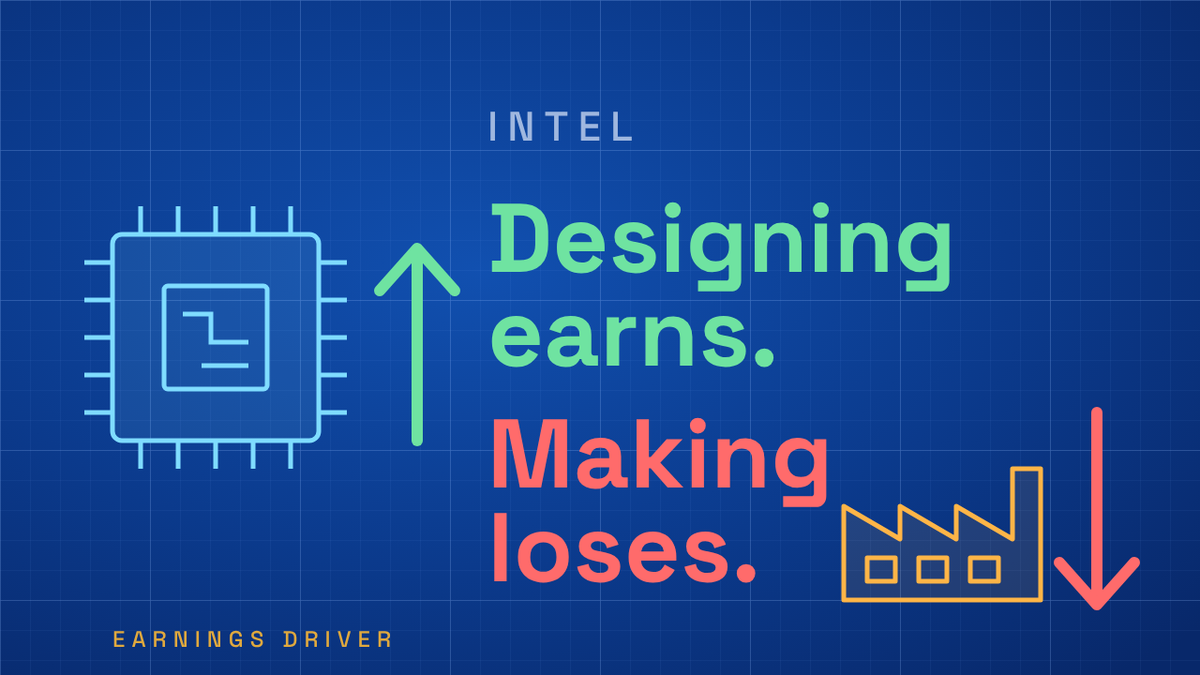
In one line: Intel earns its profit by selling chips for data centers and PCs, and loses much of that profit in Intel Foundry, the business that runs Intel's factories. Watch Intel Foundry's revenue from outside customers against Intel Foundry's operating income (here, a loss).
At a glance
- Latest: in July–September 2026, Intel Foundry's revenue from outside customers was $411 million, about 6% of Intel Foundry's $6.7 billion of revenue. Most of the rest was Intel's own chip business buying from Intel's factories. Intel Foundry's operating loss was $1.85 billion, against $2.32 billion a year earlier.
- Biggest risk: Intel plans to raise capital spending strongly in 2027 and has not yet named an outside customer for 14A, the chip-making process it plans to start producing in 2028.
- Reports: Quarterly. Next results: see Earnings Dates.
On October 29, 2026, Intel reported revenue of $16.5 billion for July–September 2026, 21% more than a year earlier. Revenue from Intel's data center chips grew 78% to $7.3 billion. Revenue from Intel's Client Computing and Physical AI group, mostly PC chips, fell 5% to $8.1 billion.
The latest quarter against expectations
Table 1 — Intel's results and guidance against analysts' estimates
| Intel | Analysts' estimates | Compared with estimates | |
|---|---|---|---|
| Revenue, July–September 2026 | $16.51B | $16.4–16.5B | Slightly above |
| Adjusted earnings per share, July–September 2026 | $0.52 | about $0.40 | About 30% above |
| Revenue guidance, October–December 2026 | $15.0–16.0B | $17.0–17.1B | Middle of Intel's range ($15.5B) is about 9% below |
| Adjusted earnings per share guidance, October–December 2026 | $0.25 | $0.43–0.44 | About 43% below |
Analysts' estimates are consensus estimates made before Intel reported; data providers' figures differ slightly. Adjusted (non-GAAP) figures leave out items such as share-based pay and restructuring charges. Sources: Intel Q3 2026 results release; Zacks via the Associated Press; LSEG via DigitalToday; StockStory; Tradingpedia.
Intel's results for July–September were at or above analysts' estimates. Earnings per share beat estimates by much more than revenue did, partly because Intel's adjusted gross margin, 44.1%, was above the 42.0% Intel had forecast in July.
Intel's guidance for October–December was far below analysts' estimates. Intel expects its adjusted gross margin to fall to 38.0% from 44.1%. On the October 29 call, David Zinsner, Intel's finance chief, said the fall "primarily reflects lower overall revenue against our fixed cost base," meaning costs that stay the same when sales fall.
The guidance also reflects a shutdown of about two weeks at Fab 28, Intel's factory in Kiryat Gat, Israel, after an accident there in October 2026, and slower output while the factory recovers. Zinsner said the shutdown would cut October–December revenue by about $300 million and gross margin by about 2 percentage points. He expected a similar revenue loss in January–March 2027.
What it sells vs. what it earns on
Intel's revenue growth does not show where Intel loses money. In January–September 2026, Intel Products, the business that designs and sells Intel's chips, made $14.2 billion of operating income. Intel Foundry lost $6.4 billion over the same nine months.
Table 2 — Intel's segments, July–September 2026
| Segment | Revenue | Change from a year earlier | Operating income | A year earlier |
|---|---|---|---|---|
| Data Center and AI (DCAI) | $7.32B | +78% | $3.04B | $0.96B |
| Client Computing and Physical AI (CCPG) | $8.10B | −5% | $2.29B | $2.69B |
| Intel Products | $15.42B | +22% | $5.32B | $3.66B |
| Intel Foundry | $6.70B | +58% | −$1.85B | −$2.32B |
| All other | $0.69B | −30% | $0.18B | $0.10B |
| Eliminations between segments | −$6.29B | −$0.07B | $0.03B | |
| Corporate costs not assigned to a segment | −$1.06B | −$0.78B | ||
| Intel | $16.51B | +21% | $2.52B | $0.68B |
Eliminations remove Intel's sales to itself. All other includes Mobileye. A year earlier, All other also included Altera, 51% of which Intel sold in September 2025. Source: Intel Q3 2026 results release.
A processor, or CPU, runs a computer's main tasks. The Data Center and AI group sells Xeon processors for servers and custom chips designed for single customers. The Client Computing and Physical AI group sells Core Ultra processors for laptops and desktops. Together the two groups form Intel Products.
Intel Foundry makes wafers for many of Intel's processors, then packages and tests the chips. Intel Foundry sells this work to Intel Products at prices that Intel says are "intended to approximate market pricing," roughly what an outside factory would charge. Intel removes those internal sales when it adds up its total revenue. They make up most of the −$6.29 billion of eliminations in Table 2.
These internal prices do not change Intel's total operating income. They decide how much of it shows up in Intel Foundry and how much in Intel Products. So Intel Foundry's loss shows roughly how much more it costs Intel to make its chips itself than to pay an outside factory. That extra cost includes developing and starting up new processes. In August 2026, Zinsner said Intel aimed for Intel Foundry to break even by the end of 2027, though it could take until the end of 2028.
AMD designs x86 processors like Intel's but pays outside factories to make them. In July–September 2026, AMD's gross margin was 54%, against Intel's 43.0% (both GAAP; Intel's was 44.1% adjusted). The two companies sell different mixes of chips, so not all of that gap comes from factory costs.
Intel's factories use several manufacturing processes, each a generation of chip-making technology. Table 3 lists them, oldest first.
Table 3 — Intel's manufacturing processes and the chips made on them
| Process | Chips made on it | Factories | Status in 2026 |
|---|---|---|---|
| Intel 7 | 13th and 14th Gen Core PC processors, older server processors, and parts of Xeon 6 | Arizona, Israel | Expected to make almost half of Intel's own processors by revenue; Fab 28 in Israel shut after an October accident |
| Intel 3 | Xeon 6 server processors, such as Granite Rapids | Ireland | Not enough capacity to meet demand |
| 18A | Panther Lake PC processors and Clearwater Forest server processors | Arizona, Oregon | In mass production since late 2025; Intel expects it to be underused in 2027 |
| 18A-P | Nova Lake PC processors and Diamond Rapids server processors | Not stated | Launch by the end of 2026; Diamond Rapids enters volume production in 2027 |
| 14A | Coral Rapids server processors | Not stated | Production planned for 2028; Intel committed in 2026 to finish developing it, but how much 14A capacity it builds depends on orders from outside customers |
Xeon 6 processors for data centers, such as Granite Rapids, combine parts made on Intel 3 with parts made on Intel 7. Intel 4, used for some older PC processors, is left out. Factories as of 2025. Sources: Intel 2025 Form 10-K; Intel earnings call, October 29, 2026.
In October 2026, Intel said demand for its data center processors was well above supply, and that Intel 3 limited that supply. An industry-wide shortage of advanced substrates, which Intel uses in its EMIB packaging, also limited supply.
Mercury Research estimated that AMD's share of x86 server processors shipped rose to 34.5% in April–June 2026 from 27.3% a year earlier. Intel shipped the rest.
In October, an analyst asked whether weaker PC demand left factory capacity free. Zinsner said Intel would switch part of its 18A capacity in Oregon to Intel 3 to make more data center processors. Intel aims to start making Intel 3 chips in Oregon in the second half of 2027.
18A processors grew from less than 5% of Intel's PC processor revenue in January–March 2026 to nearly a third in July–September. In April 2026, Zinsner said 18A would lower Intel's gross margin noticeably. A new process costs more per chip until its yields rise.
What moves the profit
Operating income ≈ Intel Products operating income + Intel Foundry operating income − Corporate costs not assigned to a segment
- Intel Products operating income. Processors sold × (Price per processor − Cost per processor) − research and development and marketing. The cost per processor includes what Intel Products pays Intel Foundry. Reported every quarter for DCAI and CCPG.
- Processors sold and price per processor. Not disclosed as numbers. Intel's quarterly report (Form 10-Q) gives the percentage change in server and PC processor units and in their average selling price.
- Intel Foundry operating income. Wafers made × Price per wafer − Factory costs. Reported every quarter. Intel gives revenue from outside customers on its earnings call and in its 10-Q.
- Factory costs and yield. Factory costs include equipment, buildings and the work of starting new processes. A lower yield raises the cost of each good chip. Neither is disclosed. Both show in Intel Foundry's operating loss and in Intel's gross margin.
- Corporate costs not assigned to a segment. Costs Intel keeps outside its segments, such as share-based pay and restructuring charges. These costs do not move with chip sales or factory use. Reported every quarter.
Reading the earnings: what to watch, and how
Intel's results release, quarterly report and earnings call are all at intc.com.
- Intel Foundry's revenue from outside customers, against Intel Foundry's operating loss.
Read it: More wafers, whether for Intel's own chips or for outside customers, spread factory costs and narrow the loss. Only outside orders add to Intel's total revenue, because Intel's sales to itself cancel out.
Latest: outside revenue was $411 million in July–September 2026, against $293 million in April–June. Intel Foundry's total revenue rose $0.93 billion from April–June, mostly from Intel's own orders, and its operating loss narrowed to $1.85 billion from $2.09 billion. - DCAI revenue, split into server units and price.
Read it: while supply is short, unit growth shows how many more server processors Intel could make. Growth in the average selling price shows a shift to costlier processors or price rises.
Latest: in July–September 2026, server units rose 10% from a year earlier, and their average selling price rose 54%, mostly because Intel sold more of its costlier processors. Other DCAI revenue, which includes custom chips, rose $743 million from a year earlier to $1.4 billion. - Gross margin, against the reasons Intel gives in advance.
Read it: Intel names what it expects to move its gross margin when it gives its forecast. A fall that the named reasons do not explain points to emptier factories, lower yields or lower prices.
Latest: GAAP 43.0% in July–September 2026, against 38.2% a year earlier (adjusted: 44.1% and 40.0%). Intel expects 37.1% (38.0% adjusted) for October–December. - PC processor units, against PC shipments.
Read it: Intel sells its chips before PC makers ship the PCs. So units falling much less than PC shipments can mean PC makers are building up chip inventories, which they later cut.
Latest: in July–September 2026, Intel's PC processor units fell 14% from a year earlier and their average selling price rose 9%, while IDC, a research firm, estimated PC shipments fell 20.1%. Intel expects CCPG revenue in October–December to be more than 20% lower than in July–September, as PC makers reduce their chip inventories.
Leading indicators (outside Intel's filings)
- PC shipments. Estimates of how many PCs PC makers shipped, published in the first two weeks after a quarter ends, before Intel reports.
- When: quarterly.
- Where: IDC and Gartner.
- Latest: IDC estimated 62.7 million PCs shipped in July–September 2026, 20.1% fewer than a year earlier. IDC said the fall followed heavy buying by PC makers and sellers in the first half of 2026, ahead of price rises caused by memory costs.
- DRAM contract prices. What PC and server makers pay for memory chips. Higher memory prices raise the cost of making a PC and can cut the number of PCs sold.
- When: forecasts for each quarter, updated monthly.
- Where: TrendForce, a market research firm.
- Latest: on September 30, 2026, TrendForce expected conventional DRAM (memory chips other than HBM) contract prices to rise 10–15% in October–December 2026 from the quarter before.
What Wall Street is asking
Across Intel's last four earnings calls, from January to October 2026, analysts kept returning to a few questions.
- "Can Intel make enough data center processors to keep its share against AMD and Arm-based chips?" In October, Zinsner said: "I really see market share next year being a function of supply," meaning Intel's share in 2027 would depend on how many processors it could make.
- "When will outside customers commit to Intel Foundry's 14A process?" In October, Lip-Bu Tan, Intel's chief executive, said he expected a couple of customers to be ready to announce within two quarters of the October call.
- "When will 18A stop lowering Intel's gross margin?" In October, Zinsner said Intel 18A costs had fallen about 40% since January–March 2026 as yields and production speed improved. He said Panther Lake, Intel's first PC processor on 18A, was "not yet at or above the corporate average" for gross margin.
- "Will Intel produce positive free cash flow in 2027 while capital spending rises?" In October, Zinsner said Intel expected capital spending of about $20 billion for 2026 and "up strongly" in 2027. He said Intel would probably not have positive free cash flow in 2027.
- "What will it take for PC demand to recover from the memory shortage?" In October, Zinsner said Intel did "not expect a sustained recovery until memory availability improves and pricing begins to normalize."
A note on valuation
On October 30, 2026, Intel's shares closed at $65.76, a price-to-earnings ratio of about 48 on Intel's adjusted earnings per share of $1.38 for the 12 months from October 2025 to September 2026. On a GAAP basis, Intel reported a net loss of $11.4 billion for January–September 2026. It was caused by a non-cash accounting loss of $12.6 billion. Under a 2025 deal that gave the US government 9.9% of Intel, some of the government's shares are held back until Intel receives certain grant money. As Intel's share price rose in January–September 2026, those shares became worth more, and Intel recorded the increase as a loss. Adjusted figures leave that loss out.
The bottom line
Processors earn Intel its profit, and higher server prices, mostly from costlier models, drove most of its data center growth. Intel Foundry's loss narrowed each quarter of 2026, and 18A chips got cheaper to make. Outside customers still bring Intel Foundry little revenue, and Intel has named none for 14A.
Why does a chip factory have to stay full to earn back what it cost? In Earnings Driver, the chapter on Nvidia and TSMC shows why designing chips and building them earn in opposite ways.
Sources: Intel Q3 2026 results release (October 29, 2026); Intel Q2 2026 and Q1 2026 results releases; Intel Q4 2025 results release (January 22, 2026); Intel Q3 2025 results release; Intel Form 10-Q for the quarters ended March 28 and September 26, 2026; Intel Form 10-K for 2025; Intel earnings calls of January 22, April 23, July 23 and October 29, 2026; Intel at the Deutsche Bank Technology Conference (August 26, 2026); AMD Q3 2026 results release (November 3, 2026); IDC (October 8, 2026); TrendForce via TechNews (September 30, 2026); Mercury Research via The Register (August 21, 2026); analysts' estimates from Zacks via the Associated Press, LSEG via DigitalToday, StockStory and Tradingpedia (October 29–30, 2026); share price as of October 30, 2026.
For sources that work for any company — filings, earnings calendars, consensus estimates — see Where to find the numbers.
Educational only, not investment advice. Figures as of the periods noted.