Apple Sells iPhones. Services Earn Two-Fifths of Apple's Gross Profit.
Apple earns most of its revenue from iPhones and other devices, and much of its gross profit from Services, such as App Store fees and subscriptions, sold to the owners of those devices. Watch the products gross margin as memory chip prices rise, and Services revenue growth.
In one line: Apple earns most of its revenue from iPhones and other devices, and much of its gross profit from Services, such as App Store fees and subscriptions, sold to the owners of those devices. Watch the products gross margin as memory chip prices rise, and Services revenue growth compared with its growth a year earlier.
At a glance
- Latest: in July–September 2026, the products gross margin was 37.2%, down from 40.1% in April–June. Most of that fall came from smaller refunds of US tariffs that Apple had paid earlier: refunds added more than 2.5 percentage points to the products margin in April–June, and less in July–September. Not counting refunds, Apple said the products margin fell about 1 point, mainly because of memory costs. Services revenue grew 10% from a year earlier, against 15% growth a year before.
- Biggest risk: memory chip prices rose sharply in 2026, and Apple expects higher memory costs to lower its overall gross margin in October–December 2026. Apple also expects slower Services growth in October–December, mainly because of third-party licensing, which includes payments from Google, and currency.
- Reports: Quarterly. Next results: see Earnings Dates.
On November 2, 2026, Apple reported revenue of $114.5 billion for July–September 2026, 12% more than a year earlier. iPhone revenue grew 17% from a year earlier to $57.6 billion, and Services revenue grew 10% to $31.6 billion.
The latest quarter against expectations
Table 1 — Apple's results and guidance against analysts' estimates
| Apple | Analysts' estimates | Compared with estimates | |
|---|---|---|---|
| Revenue, July–September 2026 | $114.5B | $113.4–113.5B | About 1% above |
| Earnings per share, July–September 2026 | $2.10 | $1.99–2.00 | About 5% above |
| Revenue guidance, October–December 2026 | Growth of 7–10% ($153.8–158.1B) | $152.0–153.4B | Middle of Apple's range ($156.0B) is about 2% above |
Analysts' estimates are consensus estimates made before Apple reported. Data providers' figures differ slightly. Apple does not publish adjusted figures, so all its figures follow standard accounting rules (GAAP). Apple gives its revenue guidance as growth from a year earlier. The dollar range applies that growth to October–December 2025 revenue of $143.8 billion. October–December, which includes the holiday season, is usually Apple's biggest quarter. Sources: Apple's results release and earnings call for July–September 2026; Bloomberg via Yahoo Finance; LSEG via Reuters; Visible Alpha; Investing.com.
iPhone and Mac revenue were above analysts' estimates for July–September 2026, Services was in line, and the iPad category and the Wearables, Home and Accessories category were below. Greater China revenue was $17.5 billion, below estimates of about $18.6–18.8 billion. Apple's overall gross margin, for products and Services together, was 47.9%, including about 1 percentage point from refunds of US tariffs. In February 2026, the US Supreme Court ruled that tariffs that the US had imposed under an emergency law were not allowed. Apple has received refunds of those tariffs since then.
Apple's revenue guidance for October–December 2026 is above analysts' estimates. Apple expects its gross margin to fall to 45–46% in October–December, from 47.9% in July–September. Not counting tariff refunds, the July–September margin was about 47%. Kevan Parekh, Apple's finance chief, said the fall comes mainly from higher memory costs, and partly from the cost of offering Siri AI, Apple's rebuilt voice assistant. Apple expects Services revenue to grow 8–9% from a year earlier in October–December, against 10% in July–September, mainly because of third-party licensing and currency. A stronger dollar lowers the dollar value of sales made in other currencies. Apple did not say how much third-party licensing payments would change.
What it sells vs. what it earns on
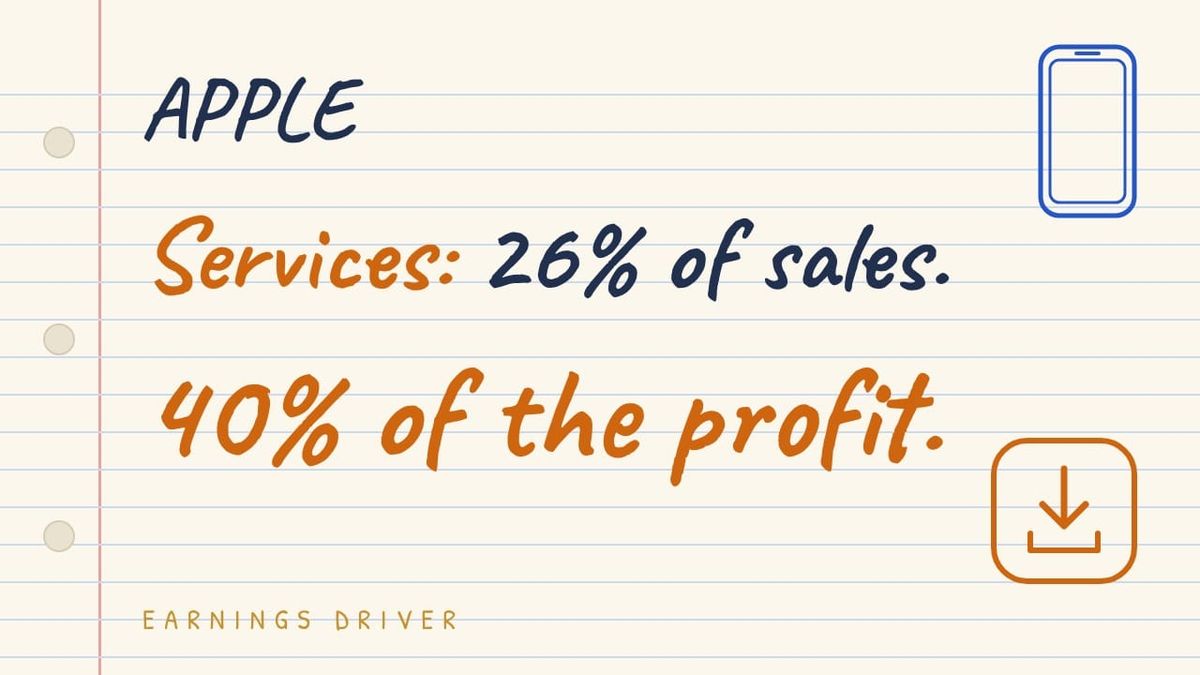
In fiscal 2026 (October 2025–September 2026), Services was 26% of Apple's revenue but earned 40% of Apple's gross profit. iPhone alone was 53% of revenue.
Table 2 — Apple's revenue and gross profit, fiscal 2026 (October 2025–September 2026)
| Revenue | Gross profit | Gross margin | |
|---|---|---|---|
| iPhone | $254.1B | ||
| Mac | $37.9B | ||
| iPad | $27.9B | ||
| Wearables, Home and Accessories | $35.6B | ||
| Products | $355.5B | $139.7B | 39.3% |
| Services | $123.3B | $93.9B | 76.2% |
| Apple | $478.8B | $233.6B | 48.8% |
Apple reports gross profit for products and Services, not for each device. From fiscal 2025, iPhone revenue grew 21%, Mac 13% and Services 13%, while iPad and Wearables, Home and Accessories were about the same. Source: Apple's results release for July–September 2026.
Products still earned 60% of gross profit in fiscal 2026 and most of the growth in gross profit: products gross profit rose $26.8 billion from fiscal 2025, and Services gross profit $11.6 billion.
Apple sells iPhones, Macs, iPads and wearables around the world, through its own stores and website, mobile phone companies and other retailers. The Americas were 41% of fiscal 2026 revenue, Europe 27%, Greater China 17%, and Japan and the rest of Asia Pacific 15%. Apple stopped reporting how many iPhones it sells in fiscal 2019. IDC, a research firm, estimated that Apple shipped 247.8 million iPhones in calendar 2025. In November 2026, Apple said more than 2.5 billion of its devices were in active use.
Most of Services is what Apple sells to people who already own its devices. It includes the commission Apple charges on purchases made through the App Store, advertising, iCloud storage, AppleCare, Apple Pay and Apple Card, and subscriptions such as Apple Music and Apple TV. Most of Apple's services cost it little for each extra sale, unlike devices.
Services also includes licensing payments, which Apple's annual report says include revenue from Google. Court documents showed that Google paid Apple about $20 billion in 2022 to be the default search engine in Safari, Apple's web browser. No figure for later years has been made public.
The products gross margin depends partly on the price of memory, one of the parts Apple buys for each device. Memory chip prices rose sharply in 2026 as companies building AI data centers bought more memory chips.
Research and development rose 32% from fiscal 2025 to $45.8 billion in fiscal 2026. In July 2026, Apple said it was spending more on AI. Apple launched Siri AI as a test version in September 2026.
What moves the profit
Operating income ≈ Devices sold × (Price per device − Cost per device) + Services revenue × Services gross margin − Research and development − Selling, general and administrative costs
- Devices sold and price per device. Not disclosed as numbers. Apple reports revenue by product category every quarter.
- Cost per device. Not disclosed. It shows in the products gross margin, which Apple reports every quarter.
- Services revenue. Reported every quarter. It grows with the number of devices in use, the share of users who pay for at least one service, how much each one spends, and licensing and advertising payments from other companies, such as Google. Apple does not break Services revenue down by service.
- Services gross margin. Reported every quarter. Apple does not report it for each service.
- Research and development, and selling, general and administrative costs. Reported every quarter. In fiscal 2026, these costs grew $13.4 billion from fiscal 2025, while gross profit grew $38.4 billion, so operating income grew $25.0 billion.
Reading the earnings: what to watch, and how
Apple's results release, quarterly report and earnings call are all at investor.apple.com.
- iPhone revenue.
Read it: iPhone sales bring in new users and keep existing ones on Apple devices, and both can pay for Services. When Apple says it cannot build enough iPhones, as it did for July–September 2026, iPhone revenue may show how many it could build rather than how many people wanted.
Latest: up 17% from a year earlier to $57.6 billion in July–September 2026. - The products gross margin, against memory costs and Apple's prices.
Read it: a 1-percentage-point change in the products gross margin moves Apple's gross profit by about $3.6 billion a year, at fiscal 2026 products revenue of $355.5 billion. A falling margin may mean that Apple's price increases did not make up for higher memory costs, though a change in the mix of models also moves it.
Latest: 37.2% in July–September 2026, down from 40.1% in April–June, mostly because tariff refunds added more than 2.5 percentage points in April–June and less in July–September. Not counting refunds, Apple said the products margin fell about 1 point, mainly because of memory costs. - Services revenue growth.
Read it: in fiscal 2026, the Services gross margin was about twice the products gross margin (Table 2), so a dollar of Services revenue adds about twice the gross profit of a dollar of product sales. Slower growth may come from currency, changes to App Store rules or changes in third-party licensing payments, which Apple names on its earnings calls.
Latest: up 10% from a year earlier in July–September 2026, against 12% in April–June and 15% in July–September 2025. - The Services gross margin.
Read it: a 1-percentage-point change in the Services gross margin moves Apple's gross profit by about $1.2 billion a year. A falling margin may mean that lower-margin services or the cost of running Siri AI are growing faster than App Store fees and licensing payments.
Latest: 76.0% in July–September 2026, against 75.3% a year earlier.
Leading indicators (outside Apple's filings)
- Smartphone shipments (demand). Estimates of how many phones makers shipped, published in the month after a quarter ends, before Apple reports.
- When: quarterly.
- Where: IDC, Omdia and Counterpoint Research.
- Latest: Omdia estimated that 254.7 million smartphones shipped worldwide in July–September 2026, 20% fewer than a year earlier, and said higher phone prices held back demand. It estimated 56.5 million iPhones, about the same as a year earlier. Apple's iPhone revenue grew much faster than these shipments in the same months, which suggests that the average selling price per iPhone rose from a year earlier.
- DRAM contract prices (cost). What device makers pay for memory chips. Higher prices raise Apple's cost per device.
- When: forecasts for each quarter, updated monthly.
- Where: TrendForce, a market research firm.
- Latest: on September 30, 2026, TrendForce expected contract prices for conventional DRAM, the memory used in phones, PCs and ordinary servers, to rise 10–15% in October–December 2026 from the quarter before.
What Wall Street is asking
Across Apple's last four earnings calls, from January to November 2026, analysts kept returning to a few questions.
- "Can price rises offset higher memory costs?" In November, John Ternus, Apple's chief executive since September 1, 2026, said price increases on Macs and iPads in June and on iPhones in September offset some of the higher memory costs, and so did lower costs for other parts.
- "How long will supply limit iPhone, Mac and iPad sales?" In November, Sabih Khan, Apple's chief operating officer, said limits on chipmaking capacity were easing, but that memory would limit Mac and iPad sales in October–December 2026.
- "Why is Services revenue growing more slowly?" In November, Parekh said currency was the main reason that Services growth from a year earlier slowed in July–September 2026. He also named weaker mobile gaming in the App Store, changes to the App Store business model in some countries and a US court ruling on purchases made outside the App Store.
- "How will Siri AI affect Apple's gross margin?" In November, Parekh said the cost of running Siri AI in Apple's data centers will count as a cost of Services.
- "How fast is Apple's revenue in Greater China growing?" In November, Ternus said Greater China revenue grew 21% from a year earlier in July–September 2026 and 28% in fiscal 2026.
A note on valuation
On November 2, 2026, Apple's shares closed at $338.32, a price-to-earnings ratio of about 38 on earnings per share of $8.98 for fiscal 2026 (October 2025–September 2026). At the ends of fiscal 2023, 2024 and 2025, the ratio was between about 28 and 37. Apple spent $86.4 billion buying back its own shares in fiscal 2026. The number of its shares fell about 2% from fiscal 2025.
The bottom line
Devices bring in most of Apple's revenue, while Services earn much of its gross profit. Higher memory costs are lowering its products gross margin, though price rises cover part of them. Apple expects Services growth to slow, and has not said how much licensing payments, including Google's, will change.
How much of what people spend inside phone apps goes to Apple? In Earnings Driver, the chapter on video games shows that the App Store and Google Play take up to 30% of what is spent inside apps, and that games account for nearly half of that spending.
Sources: Apple results release for July–September 2026 (November 2, 2026); Apple results releases for October 2025–June 2026; Apple Form 10-K for fiscal 2025 and Form 10-Q for April–June 2026; Apple earnings calls of January 29, April 30, July 30 and November 2, 2026; US v. Google court documents (2024); IDC (January 2026); Omdia (October 29, 2026); TrendForce via TechNews (September 30, 2026); analysts' estimates from Bloomberg via Yahoo Finance, LSEG via Reuters, Visible Alpha and Investing.com (October 30–November 2, 2026); share price as of November 2, 2026; past price-to-earnings ratios from Wisesheets.
For sources that work for any company — filings, earnings calendars, consensus estimates — see Where to find the numbers.
Educational only, not investment advice. Figures as of the periods noted.