Meta Gives Its Apps Away. It Earns on How Well Its Ads Work.
Meta earns almost all of its revenue from ads in its free apps, such as Facebook, Instagram and WhatsApp, and it earns more as each ad leads to more purchases for advertisers. Watch whether Meta's cash from operations covers its spending on data centers and servers.
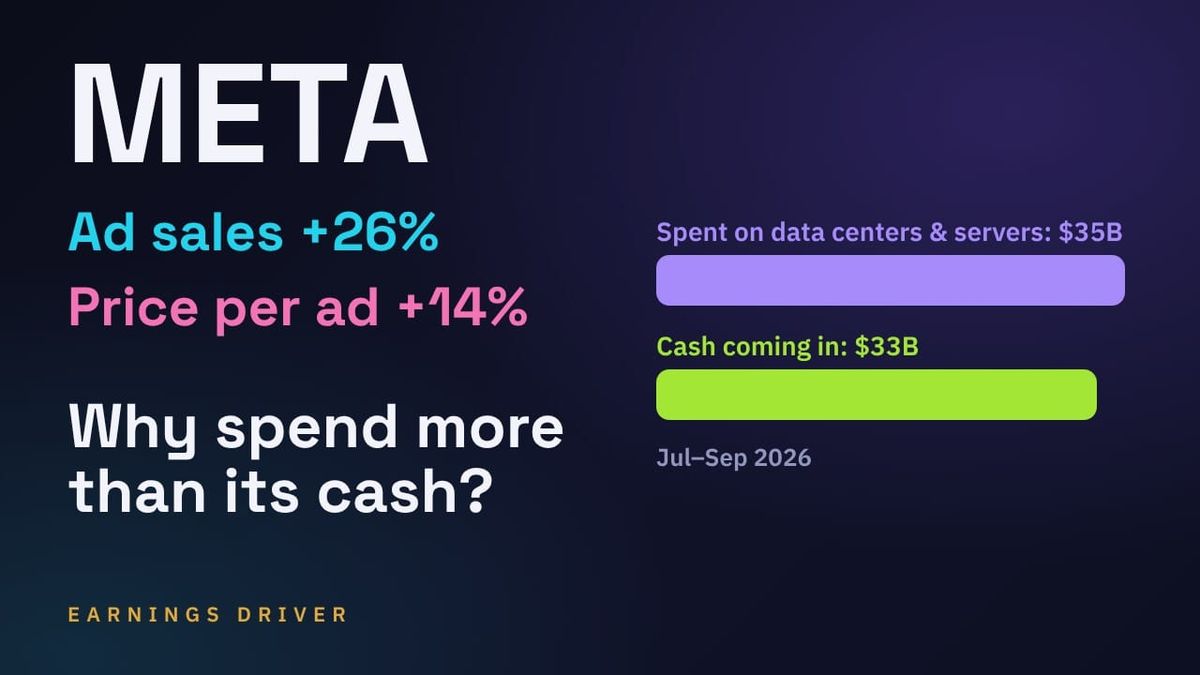
In one line: Meta earns almost all of its revenue from ads in its free apps, such as Facebook, Instagram and WhatsApp, and it earns more as each ad leads to more purchases for advertisers. Watch whether Meta's cash from operations covers its spending on data centers and servers.
At a glance
- Latest: in July–September 2026, Meta's cash from operations was $32.8 billion. Its capital spending, including payments on finance leases, was $34.9 billion. That left free cash flow of about −$2.1 billion, against $10.6 billion a year earlier.
- Biggest risk: Meta expects to spend about twice as much on data centers and servers in 2026 as in 2025. It says Muse and its other new AI products can begin adding revenue in 2027.
- Reports: Quarterly. Next results: see Earnings Dates.
On October 21, 2026, Meta Platforms (Meta) reported revenue of $64.6 billion for July–September 2026, up 26% from a year earlier.
The latest quarter against expectations
Table 1 — Meta's results and guidance against analysts' estimates
| Revenue, July–September 2026 | Revenue guidance, October–December 2026 | |
|---|---|---|
| Meta | $64.6B | $73B–$76B |
| Analysts' estimates | $63.3B–$63.4B | $73.7B |
| Compared with estimates | About 2% above | Middle of Meta's range ($74.5B) is about 1% above |
Analysts' estimates are consensus estimates made before Meta reported, from LSEG (via NewsBytes, October 22, 2026) and the Associated Press (October 21, 2026). Source: Meta's results release for July–September 2026.
Earnings per share was $3.83 (GAAP), or $7.40 without a legal charge of $9.89 billion. Published estimates differed on whether they included the charge, so the table leaves earnings per share out.
The charge comes from an agreement Meta announced in August 2026 with 52 attorneys general from US states, territories and the District of Columbia. The agreement settles lawsuits over teen mental health and social media. Meta will pay up to about $18.6 billion over 10 years, and it will set a default two-hour daily limit for teens on Facebook and Instagram.
For October–December 2026, Meta expects revenue of $73 billion–$76 billion. It expects changes in exchange rates to lower growth from a year earlier by about 1 percentage point.
What it sells vs. what it earns on
Meta's apps are free to use. Meta's daily active people, those who used at least one of its apps on a given day, averaged 3.64 billion in September 2026, 3% more than a year earlier. Meta sells advertisers the chance to show ads to those people in their Facebook and Instagram feeds, Stories and short videos (Reels). They are not searching for anything, so an ad has to catch their attention.
Table 2 — Meta's revenue and operating income by segment, July–September 2026
| Family of Apps | Reality Labs | Total | |
|---|---|---|---|
| Revenue | $64,158M | $443M | $64,601M |
| A year earlier | $50,772M | $470M | $51,242M |
| Operating income | $17,117M | −$4,129M | $12,988M |
| A year earlier | $24,967M | −$4,432M | $20,535M |
Family of Apps is Facebook, Instagram, Messenger and WhatsApp. Reality Labs makes Quest virtual-reality headsets and Ray-Ban Meta AI glasses. Total operating income for July–September 2026 includes the legal charge. Source: Meta results release for July–September 2026.
Ads brought in $63.1 billion, about 98% of Meta's revenue, up 26% from a year earlier. Meta reports that growth in two parts: the number of ads shown (ad impressions) rose 10%, and the average price per ad rose 14%.
Advertisers bid for each chance to show an ad to a person, and they pay more for ads that lead to more sales. Meta uses AI to choose which ad each person sees. On the earnings call, Meta's chief financial officer, Susan Li, said the price per ad rose because of "ad performance gains" and better economic conditions than in July–September 2025.
Total costs and expenses rose 68% from a year earlier to $51.6 billion, or about 36% without the legal charge (our calculation). Li said the growth came mainly from "legal-related costs, infrastructure costs, and third-party AI token costs." Infrastructure costs are depreciation, the cost of running data centers and computing rented from cloud companies. The token costs are payments to other companies for using their AI models. Operating margin was 20% (GAAP), against 40% a year earlier, and about 35% without the legal charge (our calculation). Without the charge, operating income would have been $22.9 billion, up about 11% from a year earlier.
Meta's capital spending went mostly to "servers, data centers, and network infrastructure," according to Li. Meta expects $135–145 billion of capital spending in 2026, about twice its $72.2 billion in 2025, also including finance leases.
Meta says it is building computing capacity for its own AI models and for Muse, a personal AI assistant that can carry out tasks such as shopping. On October 21, Meta's chief executive, Mark Zuckerberg, said more than 10 million people in the US and Canada had set up Muse in its first month and a half. He also said Meta has "not yet found the limit" of how much more computing can improve its apps and ads.
What moves the profit
Operating income ≈ Daily active people × Ads shown per person × Average price per ad + Other revenue − Cost of revenue − R&D − Marketing and overhead
- Daily active people. Reported every quarter, as the average for the quarter's last month.
- Ads shown per person. Not reported. It shows when growth in ad impressions, reported as the change from a year earlier for the world and by region, is compared with growth in daily active people.
- Average price per ad. Not reported as a number. Meta reports the change from a year earlier for the world and by region, based on where users are.
- Average revenue per person. Family of Apps revenue divided by daily active people, reported every quarter. It combines the three items above: $17.72 in July–September 2026, against $14.46 a year earlier.
- Other revenue. Includes fees businesses pay to message customers on WhatsApp, and subscriptions. Reported every quarter.
- Cost of revenue. Includes depreciation of servers and other equipment.
- R&D. Research and development was Meta's largest cost: $20.1 billion in July–September 2026, up 32% from a year earlier. Meta also reports its headcount every quarter.
- Reality Labs. Its costs are counted in cost of revenue, R&D, and marketing and overhead above. Meta reports the segment's operating loss every quarter.
- Capital spending. Not part of operating income. Reported every quarter, with an outlook for the year.
Reading the earnings: what to watch, and how
Meta's results release, quarterly filings (Form 10-Q) and earnings call are at investor.atmeta.com.
- Ad impressions.
Read it: impressions grow when more people use Meta's apps, when they spend more time in them, or when Meta shows more ads in each visit. If impressions grow more slowly than daily active people, people are spending less time in the apps or seeing fewer ads in each visit.
Latest: up 10% from a year earlier in July–September 2026, faster than daily active people. The fastest growth was in Asia-Pacific, at 14%. The teen time limits in the August 2026 settlement apply only in participating US states and territories, so any effect on impressions would show first in the US and Canada figures. Meta has not given a start date for the limits. - Average price per ad.
Read it: Meta's AI spending is meant to raise this, but fast impression growth where ads sell for less pulls the average down.
Latest: up 14% from a year earlier in July–September 2026, but only 1% in Asia-Pacific, against 23% in the US and Canada. - Capital spending against cash from operations.
Read it: when capital spending is larger, Meta pays the difference from its cash and marketable securities ($82.4 billion at the end of September 2026) or by borrowing.
Latest: $34.9 billion of capital spending against $32.8 billion of cash from operations in July–September 2026. - Depreciation of servers and network assets.
Read it: if this cost grows faster than ad revenue, it takes a larger share of each ad dollar, and operating margin tends to fall. If it grows more slowly, the margin tends to rise.
Latest: $5.34 billion in July–September 2026, the largest part of Meta's $7.2 billion of depreciation and amortization. It was up 48% from $3.60 billion a year earlier.
What Wall Street is asking
Across Meta's last four earnings calls, from January to October 2026, analysts kept returning to a few questions.
- "How much will Meta spend on data centers and servers next year?" In October, Li said that in 2027 Meta expects "to continue investing aggressively to support both our core business and emerging AI initiatives."
- "How much more can AI improve the results of Meta's ads?" In October, Li named three ways Meta is still improving its ads: its existing ad-ranking models, research using large language models, and AI tools that make ads for advertisers.
- "How will Muse and Meta's other AI products make money?" In October, Zuckerberg said, "For most people, the product should be free." Li said Meta sees "multiple paths to monetization, beginning with subscriptions," and that Meta's new AI products "can begin contributing incremental revenue in 2027."
- "How much will it cost to run Meta's own AI models?" In October, Zuckerberg said Muse needs a lot of computing, but Meta expects to make it more than 10 times cheaper to run within a year.
- "Will people buy things through Muse?" In October, Zuckerberg said shopping is the most common use of Muse: more than a quarter of people using Muse shop with it, with an average purchase of over $200.
A note on valuation
Meta's share price closed at $697.52 on October 21, 2026, before the results. That was a price-to-earnings ratio of about 24 on GAAP earnings per share of $29.33 for the four quarters to September 2026. Those earnings include a one-time tax benefit of $8.03 billion in January–March 2026, and legal charges of $2.40 billion in April–June and $9.89 billion in July–September 2026.
The bottom line
Advertisers paid more for each Meta ad in July–September 2026, partly because the ads worked better for advertisers. In the same months, Meta spent more on data centers and servers than its business brought in. Whether ad revenue will grow enough to cover that spending is not yet known.
Is a person scrolling a feed worth as much to an advertiser as a person searching? In Earnings Driver, the chapter on Alphabet explains how selling a person's attention differs from selling their intent to buy, and why advertisers pay differently for each.
Sources: Meta results release for July–September 2026 (October 21, 2026); Meta quarterly report on Form 10-Q for July–September 2026; Meta earnings presentation for July–September 2026 (regional ad figures and average revenue per person); Meta results releases for October–December 2025, January–March 2026 and April–June 2026; Meta earnings calls of January 28, April 29, July 29 and October 21, 2026 (transcripts from The Motley Fool and StockAnalysis); Meta newsroom, agreement with state attorneys general (August 26, 2026); NewsBytes (October 22, 2026) and the Associated Press (October 21, 2026), consensus estimates; StockAnalysis (share price, October 21, 2026).
For sources that work for any company — filings, earnings calendars, consensus estimates — see Where to find the numbers.
Educational only, not investment advice. Figures as of the periods noted.