Arm Designs the Chips Other Companies Make. It Earns a Royalty on Each One They Ship.
Arm earns a fee when a company licenses Arm's chip designs, then a royalty on each chip that company ships using those designs. Watch whether Arm's royalty revenue keeps growing while fewer phones are sold.
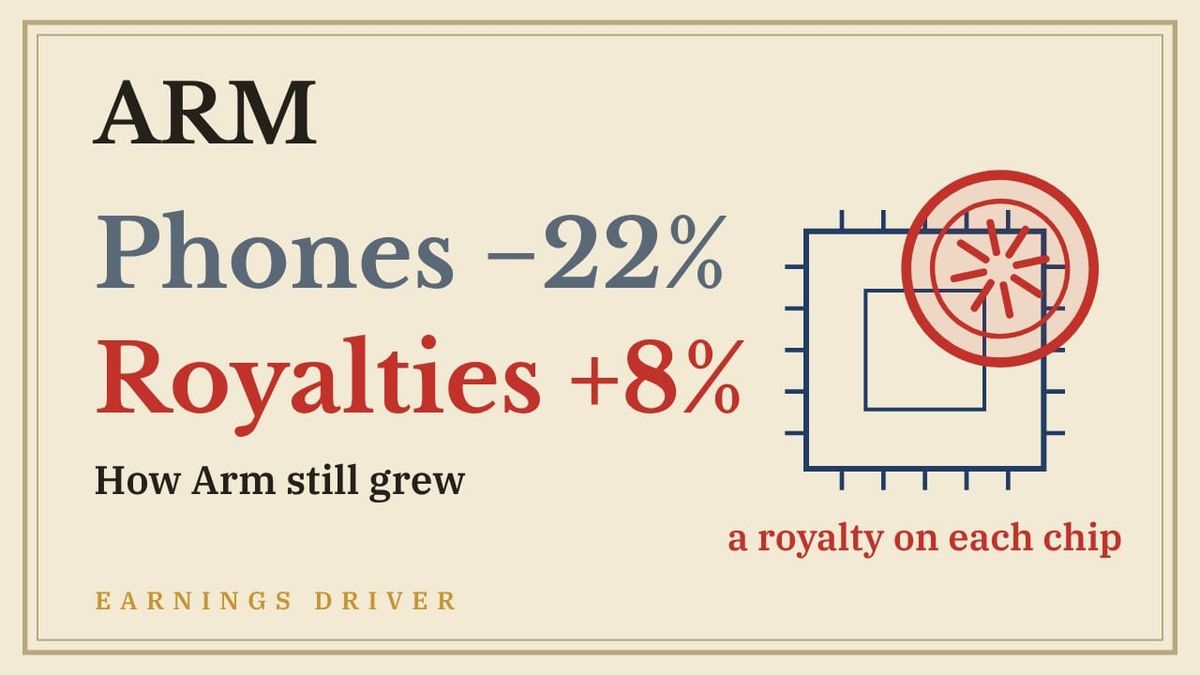
In one line: Arm earns a fee when a company licenses Arm's chip designs, then a royalty on each chip that company ships using those designs. Watch whether Arm's royalty revenue keeps growing while fewer phones are sold.
At a glance
- Latest: royalty revenue was $670 million in July–September 2026, up 8% from a year earlier, while world smartphone shipments fell 22%.
- Biggest risk: the main processors in phones brought in about 43% of royalty revenue in the year to March 2026, and phone sales are falling as the cost of memory rises. Arm has also announced a chip of its own, which will earn a much lower gross margin than royalties. The chip competes with server chips that Arm's licensees build on Arm designs.
- Reports: Quarterly. Arm's fiscal year runs from April to March. Next results: see Earnings Dates.
On November 4, 2026, Arm Holdings (Arm) reported revenue of $1.44 billion for July–September 2026, the second quarter of its fiscal 2027, up 27% from a year earlier.
Who Arm is
Arm began in Cambridge, England, in November 1990 as Advanced RISC Machines, a joint venture of Acorn Computers, Apple and VLSI Technology. In 1993, Apple's Newton handheld computer went on sale with an Arm processor. It sold poorly, and Arm adopted the way it still charges: an upfront license fee, then royalties based on the number of chips produced.
SoftBank Group bought Arm in 2016 for about £24.3 billion and listed it on Nasdaq in September 2023. SoftBank owned about 87% of Arm on March 31, 2026.
Arm designs processors and licenses them to other companies, which build their own chips. The simplest thing it licenses is an instruction set, the basic commands a processor understands. Arm also licenses complete processor designs, called cores. Its larger ready-made designs, called Compute Subsystems (CSS), combine several cores with the parts that connect the cores.
Apple, Nvidia, Amazon, Google, Microsoft, MediaTek and Qualcomm all build chips on Arm designs. Software written for one instruction set must be rebuilt or translated to run on another, and Arm says more than 30 million software developers rely on its technology. The cost of rebuilding or translating software is a big reason these companies keep paying Arm.
Arm's five largest customers brought in about 57% of its revenue in the year to March 2026. The largest, Arm China, brought in about 16%. Arm China is a separate company that resells Arm's licenses to Chinese chip companies and collects their royalties; Arm holds an indirect stake. Arm does not name those Chinese companies. In July–September 2026, about $424 million, or about 29% of Arm's revenue, came from Arm China and from SoftBank and its affiliates, which are also Arm customers.
In March 2026, Arm announced the Arm AGI CPU, the first chip it sells itself, with Meta as its lead customer. It is a server processor that works alongside the chips that run AI models. Arm built it for AI agents, programs that carry out tasks for people. Arm expects the first commercial deliveries in January–March 2027.
A chip sells for far more than the royalty on it, so each chip Arm sells brings in much more revenue, though at a lower gross margin. In March 2026, Arm said it aims for about $15 billion of chip revenue and $25 billion of total revenue in its fiscal 2031 (April 2030–March 2031), against $4.92 billion of total revenue in fiscal 2026.
The chip competes with Intel and AMD server processors, Nvidia's Vera and server chips that Arm's licensees build on Arm designs. In March 2026, Arm's chief executive, Rene Haas, said there is "room for lots of different players."
The latest quarter against expectations
Table 1 — Arm's results and guidance against analysts' estimates
| Arm | Analysts' estimates | Compared with estimates | |
|---|---|---|---|
| Revenue, July–September 2026 | $1.44B | $1.38B | About 5% above |
| License and other revenue | $773M | $625M | About 24% above |
| Royalty revenue | $670M | $721M | About 7% below |
| Adjusted earnings per share, July–September 2026 | $0.52 | $0.47–$0.48 | About 8–11% above |
| Revenue guidance, October–December 2026 | $1.49B–$1.59B | $1.53B | Middle of Arm's range ($1.54B) is slightly above |
Analysts' estimates are consensus estimates made before Arm reported, from LSEG, FactSet and Reuters. Estimates for each line come from different providers and do not add up. Adjusted figures are non-GAAP. Sources: Arm's results release and shareholder letter for July–September 2026; Reuters and MarketScreener, November 4, 2026.
Revenue was above the top of the range Arm had given in July, $1.33 billion–$1.43 billion. Against estimates, the two parts went opposite ways: license revenue was above, and royalty revenue below. In July, Arm had said it expected royalty revenue to grow by a little more than 10% from a year earlier in July–September; it grew 8%.
On the November 4 earnings call, Arm's chief financial officer, Jason Child, said license revenue was about $100 million more than Arm had expected, because more customers wanted to sign long-term agreements.
For October–December 2026, Child said Arm expects royalty revenue to grow by a few percent from a year earlier. He called the year-earlier quarter a tough comparison. He expects license revenue to grow a little over 50% from a year earlier.
What it sells vs. what it earns on
Arm's gross margin was 97.9% in July–September 2026 (non-GAAP; 97.1% GAAP). Its operating costs are much larger, mostly research and development, so its operating margin was 13.9% (GAAP; 44.2% non-GAAP, which leaves out pay in Arm shares).
Table 2 — Arm's revenue by type, July–September 2026
| July–September 2026 | A year earlier | Change | |
|---|---|---|---|
| License and other revenue | $773M | $515M | +50% |
| Royalty revenue | $670M | $620M | +8% |
| Total | $1,443M | $1,135M | +27% |
Source: Arm shareholder letter for July–September 2026.
License revenue comes from license fees, paid for the right to use Arm's designs. That right usually lasts several years. Arm said license revenue grew 50% from a year earlier because of continued strong demand for its designs, the timing and size of several large agreements, and revenue from contracts signed earlier (its backlog).
Royalties are paid later, when the licensee ships chips built on Arm's designs. Arm says each royalty is "typically a percentage of chip average selling price or a fixed fee per chip."
Royalty revenue grew 8% from a year earlier, against 22% in April–June. Arm said royalties grew because more chips use its newer designs, which carry "higher royalty rates per chip": Armv9, the newest version of its instruction set, and CSS. It also said "data center royalties doubled year over year," and that growth "was partially offset by the impact of memory pricing on the smartphone market."
What moves the profit
Operating income ≈ Arm-based chips shipped × Royalty per chip + License fees + Chip revenue − Cost of making chips − R&D − Marketing and overhead
- Arm-based chips shipped. Not reported every quarter or by market; it shows in royalty revenue. Arm's partners shipped more than 10 billion Arm-based chips in July–September 2026, a first for one quarter. The main processors in phones brought in about 43% of royalty revenue in the year to March 2026.
- Royalty per chip. Not disclosed. It also shows in royalty revenue, and rises as customers move to newer designs.
- License fees. Reported every quarter as license and other revenue. Arm also reports annualized contract value, its measure of license fees it expects each year from contracts already signed.
- Chip revenue and cost of making chips. None yet; Arm expects first deliveries of the Arm AGI CPU in January–March 2027. Arm will report chip revenue separately once chip revenue reaches 10% of total revenue, which Arm expects in fiscal 2028 (April 2027–March 2028).
- R&D. Research and development is Arm's largest cost: $857 million GAAP, including share-based pay, in July–September 2026, against revenue of $1,443 million.
Reading the earnings: what to watch, and how
Arm's results release, shareholder letter and quarterly filings (Form 6-K) are at investors.arm.com.
- Royalty revenue growth, against phone shipments.
Read it: royalty revenue growing while fewer phones are sold means higher royalty rates and more data center chips are making up for fewer phone chips. If royalty revenue falls from a year earlier, those gains are no longer enough.
Latest: $670 million in July–September 2026, up 8% from a year earlier, against 22% growth in April–June. IDC put July–September phone shipments 22% below a year earlier. - Data center royalties.
Read it: the faster data center royalties grow, the less Arm's royalties depend on phones. If data center royalties grow more slowly while phone sales fall, Arm's total royalty growth slows.
Latest: Arm said data center royalties doubled from a year earlier in July–September 2026, but does not report the amount. In November, Arm's chief executive, Rene Haas, said Amazon, Google, Microsoft and Nvidia pay most of these royalties. - License revenue and annualized contract value.
Read it: license fees are paid before chips ship, so a rise can mean more royalties in later years, and a fall can mean fewer. Large agreements make license revenue jump from quarter to quarter; annualized contract value moves more smoothly.
Latest: license and other revenue was $773 million in July–September 2026, up 50% from a year earlier. Annualized contract value was $1.79 billion, up 12% from a year earlier. - Revenue and gross margin from the Arm AGI CPU.
Read it: chip sales keep much less gross profit than royalties, so Arm's gross margin will fall as the chip grows. If data center royalties keep growing as chip sales grow, the chip is adding to Arm's business; if they slow, chip sales may be replacing royalties.
Latest: no chip revenue yet. In July, management put the first chip's gross margin in the high 30s to low 40s, as a percentage of chip revenue.
Leading indicators (outside Arm's filings)
- Smartphone shipments (chips shipped).
- When: quarterly, about two weeks after each quarter ends, before Arm reports.
- Where: IDC and Counterpoint Research press releases.
- Latest: 255.3 million phones in July–September 2026, 22% fewer than a year earlier (IDC, preliminary). IDC does not expect phone shipments to recover before 2028.
- Arm's share of server processors (chips shipped, data center).
- When: quarterly.
- Where: Mercury Research estimates, reported in the technology press.
- Latest: Arm-based chips were 13.2% of all server processors shipped in January–March 2026, up from 12.5% in October–December 2025.
What Wall Street is asking
Across Arm's last four earnings calls, from February to November 2026, analysts kept returning to a few questions.
- "Will the Arm AGI CPU reach Arm's goal of up to $2 billion of revenue over fiscal 2027 and 2028?" In November, Arm said its confidence in that figure had increased over the past three months.
- "How far will falling phone sales cut royalties?" In November, Child said royalties from phones, PCs and other consumer devices were roughly flat from a year earlier in July–September, and that he expected these royalties to grow again in January–March 2027.
- "Can Arm-based processors keep winning in data centers against x86 chips?" In November, Arm said Arm-based chips had more than 50% of the server market at the largest cloud companies in 2025. It expects that share to exceed 60% by the end of 2026.
- "Will license revenue stay this high?" In November, Child said license revenue would be higher in October–December than in July–September, and higher again in January–March 2027.
- "How fast will Arm's operating costs grow?" In November, Arm said it expects about $825 million of non-GAAP operating expenses in October–December 2026, against $774 million in July–September. Both figures leave out pay in Arm shares.
A note on valuation
Arm's share price closed at about $192 on November 4, 2026, before the results. That was about 96 times Arm's adjusted earnings per share for the four quarters to September 2026 ($2.00). On GAAP earnings per share ($0.88), the multiple was about 218 times. Share-based pay, pay to employees in Arm shares, explains most of the gap. In July–September 2026, it was $376 million, against a $436 million gap between adjusted and GAAP net income.
The bottom line
Companies keep paying Arm largely because so much software is already written for Arm's designs. In July–September 2026, royalties grew more slowly than in April–June as phone sales fell. Whether data centers and Arm's own chip can make up for weaker phone royalties is not yet known.
Why would a company keep paying for a design when it could switch? In Earnings Driver, the chapter on Nvidia and TSMC shows how years of software written for one design keep customers paying for it, even when a rival can build a faster chip.
Sources: Arm results release and shareholder letter for July–September 2026 (November 4, 2026); Arm shareholder letter for April–June 2026 (July 29, 2026); Arm annual report on Form 20-F for the year to March 2026; Arm official history, newsroom.arm.com; arm.com, "Build the Future of AI on Arm"; Arm UK annual report for the year to March 2026; Arm IPO pricing announcement (September 13, 2023); CNBC, "Apple and Arm sign deal for chip technology that goes beyond 2040" (September 6, 2023); Arm quarterly report on Form 6-K for July–September 2026; Arm earnings calls of February 4, May 6, July 29 and November 4, 2026; Arm AGI CPU announcement, Arm Everywhere media Q&A transcript, and Reuters, Bloomberg and Barron's reports (March 24, 2026); Reuters and MarketScreener (consensus estimates, November 4, 2026); AskTraders and TradingKey (share price, November 4, 2026); IDC smartphone shipments (October 2026); Mercury Research via the technology press (June 2026).
For sources that work for any company — filings, earnings calendars, consensus estimates — see Where to find the numbers.
Educational only, not investment advice. Figures as of the periods noted.