Eli Lilly Cuts Its Prices. It Earns on Selling Far More Doses While the Patent Holds.
Eli Lilly earns on selling far more doses of one compound, tirzepatide (Mounjaro and Zepbound), at lower prices while its patent is in force. Watch whether volume grows faster than price falls.
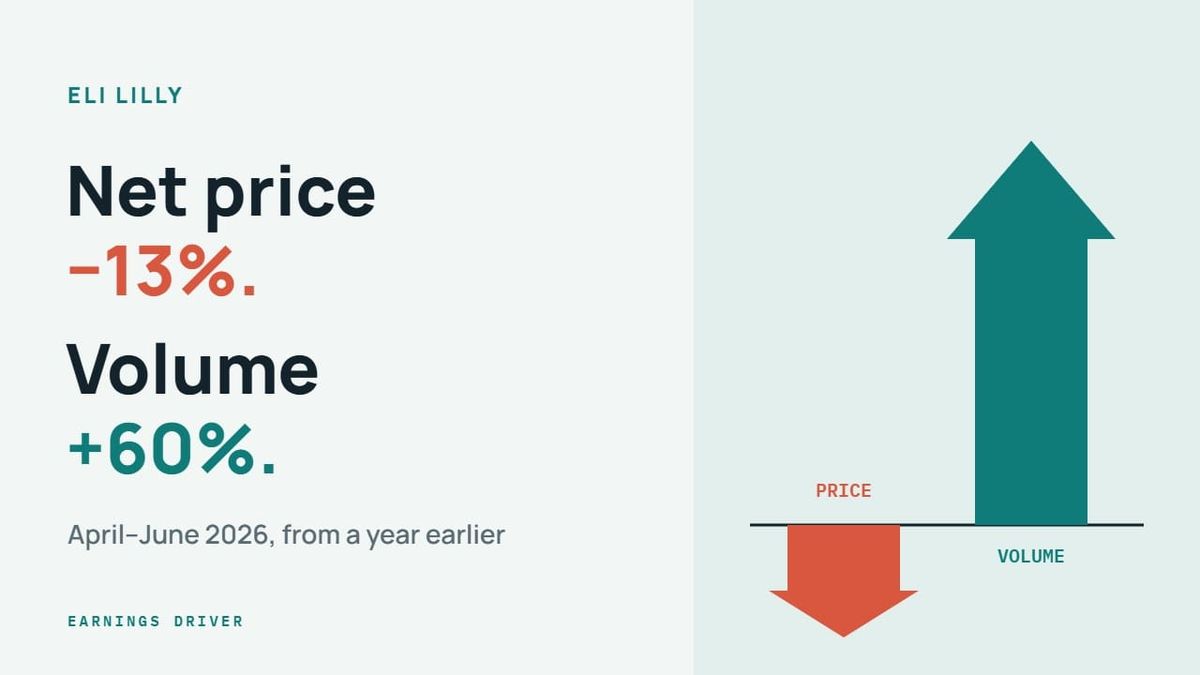
In one line: Eli Lilly earns on selling far more doses of one compound, tirzepatide (Mounjaro and Zepbound), at lower prices while its patent is in force. Watch whether volume grows faster than price falls.
At a glance
- Latest: in Q3 2026, volume +53% and net price −15%
- Biggest risk: prices falling faster than volume grows, through government price deals, insurer terms or patients switching to cheaper pills (rivals' or Lilly's own)
- Reports: Quarterly. Next results: see Earnings Dates.
On October 29, 2026, Lilly reported third-quarter revenue of $24.4 billion, up 39% from a year earlier. In the same quarter, its net prices fell 15%, while volume rose 53%. (Net price is what Lilly keeps after rebates and discounts. Lilly calls it realized price.) Volume explains the revenue growth, but not why Lilly's gross margin rose 1.0 percentage point from a year earlier, to 83.9%.
What it sells vs. what it earns on
Lilly sells prescription medicines in about 90 countries. Its largest medicine is tirzepatide. In the US it is sold as Mounjaro for type 2 diabetes and as Zepbound for obesity. In most other countries Mounjaro is sold for both. Mounjaro and Zepbound together brought in 56% of Lilly's $65.2 billion revenue in 2025.
Table 1 — Lilly's largest medicines, 2025
| Medicine | Treats | Revenue | Share of Lilly's revenue |
|---|---|---|---|
| Mounjaro | Diabetes; obesity in most countries outside the US | $23.0B | 35% |
| Zepbound | Obesity | $13.5B | 21% |
| Verzenio | Breast cancer | $5.7B | 9% |
The US accounted for 67% of Lilly's 2025 revenue.
In April 2026 Lilly launched Foundayo, its first weight-loss pill. Foundayo is a different medicine from tirzepatide and is taken once a day. Zepbound, by contrast, is injected once a week. Foundayo costs $149 a month at the lowest dose for patients who pay for it themselves.
Making one more dose costs Lilly little next to what the dose sells for. Lilly's gross margin was 83% in 2025. The large costs come before a medicine is sold: R&D and the plants to make it. R&D is not included in that margin. It cost $13.3 billion in 2025, about a fifth of revenue.
Tirzepatide's main patent, which covers the compound itself, is expected to keep copies out until 2036 in the US, 2037 in Europe and 2040 in Japan. What Lilly earns on is selling far more doses while that patent is in force.
Lilly has lowered prices to reach more patients in three ways. It sells at lower cash prices to patients who pay for the medicine themselves. Under a November 2025 agreement with the US government, it charges less to Medicare, the government's health insurance for people 65 and over. In China, it cut its price to join the national insurance list for type 2 diabetes.
What moves the profit
Operating income ≈ (Doses sold × Net price per dose) − Cost of making them − R&D − Marketing and overhead
- Doses sold. Not disclosed as a count. Instead, Lilly reports the change in volume each quarter: sales growth at unchanged prices and exchange rates.
- Net price per dose. Falls with rebates, government prices and lower cash prices, and with sales shifting to countries that pay less.
- Cost of making them. New plants add cost before they run at full capacity. Lilly says it has committed more than $50 billion to US manufacturing.
- R&D. Spending on the new medicines that must replace tirzepatide's revenue after its main patent ends, from 2036 in the US.
Reading the earnings: what to watch, and how
Lilly's results release, slides and earnings call are all at investor.lilly.com.
- Volume against price. Read it: For the US and outside the US, Lilly splits revenue growth into volume, price and currency, which add up to the total. Volume growing much faster than the price falls means revenue grows even as the price falls. Latest: in Q3 2026, volume +53% and net price −15% worldwide, +41% and −7% in the US, and +76% and −29% outside the US.
- Share of US prescriptions. Read it: Lilly's slides show its share of US prescriptions for GLP-1 medicines, the class that includes tirzepatide (Lilly calls the class incretin analogs). Latest: 60.9% in the four weeks to June 26, 2026, up from 60.5% in the four weeks to December 26, 2025. Novo Nordisk, Lilly's main rival, had 38.8%.
- Gross margin, against the reasons Lilly gives. Read it: Lilly names what moved the margin each quarter. Lower production cost and a shift toward higher-margin medicines can outweigh lower prices. Latest: 83.9% in Q3 2026, up 1.0 point from a year earlier.
- Tirzepatide's share of revenue. Read it: the higher the share, the more Lilly depends on one patent with a fixed end date. Latest: about 66% in Q3 2026 (Mounjaro $10.7 billion and Zepbound $5.4 billion of $24.4 billion), against 56% in 2025.
- R&D, against revenue. Read it: R&D rising more slowly than revenue widens the operating margin, if other costs hold steady. Latest: $4.2 billion in Q3 2026, up 23% from a year earlier, against revenue growth of 39%. R&D's share of revenue fell from about 20% to 17%.
Leading indicators (outside Lilly's filings)
- Coverage decisions. The number of patients who can get GLP-1 medicines at a low cost changes each time Medicare, Medicaid (the US program for people on low incomes) or an insurer adds or drops them. (price and volume)
- When: as announced. Where: Lilly press releases and insurer announcements.
- Latest: on July 1, 2026, Medicare began covering Zepbound and Foundayo, with patients paying $50 a month.
- Novo Nordisk's pill. Novo launched a pill version of Wegovy, its weight-loss injection, in the US in January 2026. The pill competes with Foundayo. Fast growth in the pill's prescriptions can slow Lilly's volume growth or lower Lilly's prices. (competition)
- When: quarterly; Q2 2026 results came out on August 4, a day before Lilly's. Where: Novo Nordisk earnings releases.
- Latest: more than 265,000 prescriptions in the week ending July 17, 2026.
What Wall Street is asking
Across Lilly's four earnings calls from October 2025 to August 2026, analysts kept returning to a few questions.
- "How far will Zepbound's US net price keep falling?" Some US patients had been getting Zepbound through case-by-case exceptions to their insurer's list of covered drugs. From October 1, 2026, CVS Caremark, which runs drug coverage for many US insurers and employers, planned to cover Zepbound again. More patients would then move to standard coverage. In August, finance chief Lucas Montarce said of that shift, "expect that price will actually go down for sure because of this, but it's very much embedded in our guide." By "our guide," he meant Lilly's 2026 forecast. He added, "we are going to more than offset that with volume growth."
- "Is Foundayo, Lilly's weight-loss pill, gaining prescriptions more slowly than expected?" In August, Ilya Yuffa, who runs Lilly's US business, said Foundayo had 8,000 prescribers at the April call. "We've now increased that to 36,000 prescribers," he said.
- "How many new patients will Medicare coverage bring?" Under Lilly's November 2025 agreement with the US government, Medicare covers Zepbound and Foundayo. In August, Yuffa said the coverage was "increasing access to about 35% more Americans." He estimated that "around 60% to 70%" of the patients coming in had not had access before. The White House, which announced the agreement, put Medicare's price for Zepbound at $245, below Zepbound's lowest cash price of $299 a month.
- "Can Mounjaro's volume keep growing outside the US as cheaper copies of a rival drug arrive?" In March 2026, copies of semaglutide, the compound in Novo Nordisk's Wegovy, went on sale in India after semaglutide's patent there expired. In August, Patrik Jonsson, who runs Lilly's business outside the US, said Mounjaro's prescriptions kept growing in India after the copies went on sale. He named Korea, the UK, Mexico and Germany as markets with "significant growth."
- "When will Lilly file retatrutide, its next weight-loss medicine, for approval?" In August, Lilly said it expected to file in the first quarter of 2027, after gathering more manufacturing data. Retatrutide's main trial showed 28.3% weight loss at the highest dose after 80 weeks, against 2.2% for placebo. Zepbound's main trial showed 22.5% at its highest dose after 72 weeks, against 2.4% for placebo. The two drugs have not been tested against each other.
A note on valuation
Lilly's shares closed around $1,189 on October 7, 2026, valuing the company at roughly $1.1 trillion. The share price is about 33 times the midpoint of the $35.50–36.50 adjusted earnings-per-share forecast for 2026 that Lilly gave in August. Excluding a one-time charge of $3.03 a share for drug research bought in Q2 2026, the multiple is about 30. On the same basis, with its one-time charges for bought research excluded, AbbVie traded at about 19 times its 2026 forecast.
The bottom line
Lilly is trading lower prices for far more tirzepatide doses while the patent holds. In July–September 2026, volume grew far faster than the price fell. Lilly expects Zepbound's US price to keep falling, so the test is whether volume keeps growing faster. (See: Nvidia Sells Chips. It Earns on Being Hard to Leave.)
Wondering what happens to a medicine's earnings when its patent ends? The book shows what happened to Plavix and Humira when their patents ended and copies arrived: Earnings Driver.
Sources: Lilly Q3 2026 results release (October 29, 2026) and Form 10-Q; Lilly Q2 2026 results release and slides (August 5, 2026) and Q4 2025 results (February 4, 2026), investor.lilly.com; Lilly 2025 Form 10-K; Lilly announcements on the US government agreement (November 6, 2025), Foundayo approval and launch (April 2026), the Medicare GLP-1 Bridge (June 2026) and retatrutide results (May and July 2026) and Zepbound's SURMOUNT-1 results (2022); White House fact sheet, November 6, 2025; Novo Nordisk Q2 2026 results (August 4, 2026); AbbVie Q2 2026 results (July 31, 2026); Lilly earnings calls of October 30, 2025, and February 4, April 30 and August 5, 2026; reports on generic semaglutide launches in India (March 2026); share prices as of October 7, 2026.
For sources that work for any company — filings, earnings calendars, consensus estimates — see Where to find the numbers.
Educational only, not investment advice. Figures as of the periods noted.