Coca-Cola Sells Drinks. It Earns on the Concentrate Its Bottlers Buy.
Coca-Cola earns mostly on the concentrate it sells to bottlers, at a price that rises with what the bottlers charge. Watch whether the number of drinks sold grows along with what Coca-Cola collects per case.
In one line: Coca-Cola earns mostly on the concentrate it sells to bottlers, at a price that rises with what the bottlers charge. Watch whether the number of drinks sold grows along with what Coca-Cola collects per case.
At a glance
- Latest: drinks sold (unit case volume) +5% and Coca-Cola's price and mix per case (price/mix) +2% in Q2 2026, against volume −1% and price/mix +6% in Q2 2025
- Biggest risk: price increases larger than shoppers will accept, so the number of drinks sold stops growing
- Reports: Quarterly. Next results: see Earnings Dates.
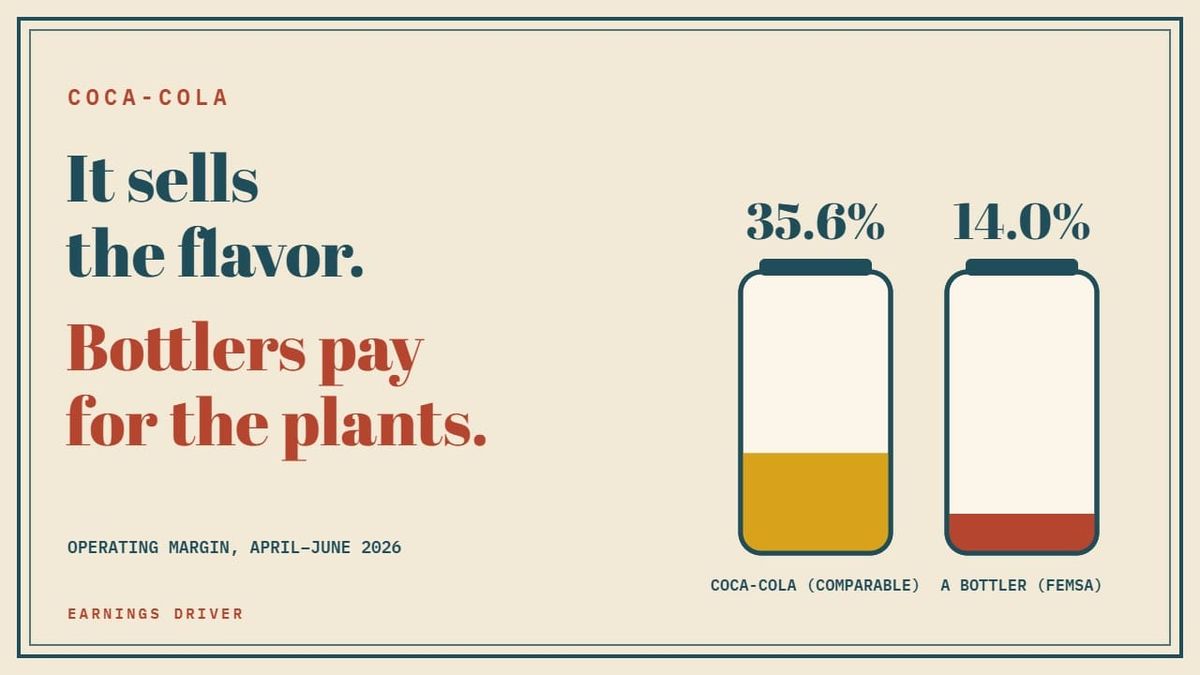
On July 28, 2026, Coca-Cola reported second-quarter revenue of $13.4 billion, up 7% from a year earlier. Its comparable operating margin was 35.6%. The bottlers that make and deliver most of its drinks have far lower margins. Coca-Cola FEMSA, a large Latin American bottler, had an operating margin of 14.0% in the same quarter. Drink sales explain Coca-Cola's revenue. They do not explain how Coca-Cola keeps more than a third of its revenue as operating income.
What it sells vs. what it earns on
Coca-Cola's drinks are sold in more than 200 countries and territories. Besides the Coca-Cola brand, they include Sprite, Fanta, Powerade and fairlife milk. Coca-Cola and its bottlers together sold 33.8 billion unit cases in 2025. A unit case is 24 eight-ounce servings, about 5.7 liters. Coca-Cola's own revenue was $47.9 billion in 2025, and the US brought in about 40% of it.
Most of those drinks are made by bottlers, companies with their own plants, trucks and sales staff. The split goes back to July 1899, when Coca-Cola gave two lawyers in Chattanooga the right to bottle Coca-Cola across most of the United States. Coca-Cola sells concentrate, the flavor base of each drink, to the bottlers. The bottlers add water and sweetener, fill the cans and bottles, and sell them to stores and restaurants. In 2025, 59% of Coca-Cola's revenue came from this concentrate business, which it reports as concentrate operations.
The other 41% came from finished drinks that Coca-Cola makes and sells itself, which it reports as finished product operations. These drinks include fairlife, juice brands, Costa coffee shops and the bottlers Coca-Cola still owns. Finished drinks bring in more revenue per case but earn lower margins. In 2025, Coca-Cola's own bottlers, reported as the Bottling Investments segment, had an operating margin of 7.4%, against a comparable operating margin of 31.2% for Coca-Cola as a whole.
Coca-Cola has sold many of its own bottlers, mostly to other bottlers. It finished selling its US bottlers in 2017 and has since sold bottlers in Vietnam, the Philippines and parts of India. Selling bottlers lowers Coca-Cola's revenue but raises its operating margin.
In October 2025 Coca-Cola agreed to sell part of its stake in Coca-Cola Beverages Africa, a bottler it controls, to Coca-Cola HBC, another bottler. The deal values all of Coca-Cola Beverages Africa at $3.4 billion. The sale had not closed by the Q2 2026 report.
Table 1 — Coca-Cola's stake in Coca-Cola Beverages Africa
| Stake | |
|---|---|
| Before the sale | 66.5% |
| To be sold to Coca-Cola HBC | 41.5% |
| After the sale closes | 25% |
Coca-Cola still owns minority stakes in several bottlers, including Coca-Cola FEMSA and Coca-Cola HBC. Its share of the profits of the companies it partly owns, mainly bottlers, was $2.0 billion in 2025. Coca-Cola reports this as equity income, which is not part of operating income.
What Coca-Cola earns on is the concentrate in each drink its bottlers sell. In most markets, Coca-Cola's concentrate price is tied to the prices its bottlers charge stores. Coca-Cola calls this incidence pricing.
Bottlers buy the cans, so they pay higher aluminum costs before those costs affect Coca-Cola. In Q2 2026, Coca-Cola Consolidated, the largest US bottler, saw its gross margin fall 2.1 percentage points from a year earlier as its aluminum costs rose more than its prices.
What moves the profit
Operating income ≈ (Unit case volume × Concentrate margin per case) + Finished-drink profit − Advertising and overhead
- Unit case volume. Drinks sold by Coca-Cola and all its bottlers. Coca-Cola reports the growth rate each quarter and the count once a year.
- Concentrate margin per case. The concentrate price minus the cost of making the concentrate. Coca-Cola does not disclose the margin per case. Changes in the concentrate price show up in price/mix (below).
- Finished-drink profit. Sales of fairlife, juices, Costa and Coca-Cola's own bottlers, minus the cost of making those drinks.
- Advertising and overhead. Advertising for Coca-Cola's brands, plus selling, distribution and administrative costs in the regions and at head office.
Reading the earnings: what to watch, and how
Coca-Cola's results releases, filings and earnings calls are all at investors.coca-colacompany.com.
- Unit case volume, by region. Read it: volume growing alongside price/mix means people keep buying more drinks at the higher prices. Latest: +5% in Q2 2026, against −1% in Q2 2025, with North America +3% and Asia Pacific +8%.
- Price/mix. Read it: the change in what Coca-Cola collects per case, from price changes and from mix, the shift between pricier and cheaper drinks, packages and countries. A fall can come from faster growth in cheaper countries rather than lower prices, so check which regions moved. Latest: +2% in Q2 2026, against +6% in Q2 2025. In Asia Pacific, price/mix fell 9%.
- Concentrate shipments against volume. Read it: shipments, which Coca-Cola calls concentrate sales, count the concentrate it sold to bottlers or used in its own finished drinks, in unit cases. Shipments grow faster than unit case volume when bottlers build up their concentrate stocks or a quarter has extra selling days. Latest: shipments +4% in Q2 2026, 1 point behind unit case volume, which Coca-Cola attributed to the timing of shipments. Added to price/mix of +2%, shipments gave organic revenue growth of 6%.
- Comparable operating margin. Read it: the operating margin excluding items such as impairments and restructuring charges. Latest: 35.6% in Q2 2026, against 34.7% a year earlier. Coca-Cola expects selling part of its stake in Coca-Cola Beverages Africa, once completed, to lift its fourth-quarter 2026 operating margin.
Leading indicators (outside Coca-Cola's filings)
- PepsiCo's North American drinks. PepsiCo, Coca-Cola's main rival, reports about three weeks before Coca-Cola. Its North American drink volume and pricing show North American drink demand, though PepsiCo can also gain or lose share against Coca-Cola. (demand)
- When: quarterly. Where: PepsiCo results releases.
- Latest: in Q3 2026, released October 8, PepsiCo's North American beverage volume fell 2%, after a 4% fall in Q2. Its pricing and mix, which PepsiCo calls effective net pricing, rose 3%.
- US carbonated-drink prices. Shelf prices reflect what bottlers charge stores. (price)
- When: monthly. Where: the US consumer price index for carbonated drinks and for food at home (Bureau of Labor Statistics).
- Latest: in the 12 months to August 2026, carbonated drink prices rose 4.4% and food-at-home prices 2.2%.
- US aluminum premium. The amount US buyers pay above the world aluminum price. Higher costs for cans lead bottlers to raise prices. Those higher prices later show up in Coca-Cola's price/mix. (cost)
- When: daily. Where: news reports of the US Midwest premium, such as Reuters.
- Latest: about $1.09 a pound in September 2026, against a record $1.19 in June.
What Wall Street is asking
Across Coca-Cola's last four earnings calls, from October 2025 to July 2026, analysts kept returning to a few questions.
- "How much of organic revenue growth will come from unit case volume, and how much from price/mix?" In April, John Murphy, the finance chief, said 3 points of growth from volume and 2 from price/mix, or the reverse, would be acceptable. In July, Henrique Braun, chief executive since March 2026, said 2026 would be a year of "balanced growth on volume and price/mix," in the second half as in the first.
- "How is pressure on lower-income shoppers affecting unit case volume and price/mix?" In July, Braun said shoppers were still buying drinks, but "the lower income continues to be pressured." He pointed to mini cans sold one at a time in convenience stores at the lowest entry price.
- "Why is price/mix weak in Asia Pacific?" In July, Braun split the decline into three roughly equal parts. One was the timing of Coca-Cola's spending in the market, which it calls investment timing. Another was spending to keep drinks affordable, which Coca-Cola calls affordability initiatives. The third was faster growth in India and China, where drinks sell for less.
- "How can Coca-Cola's operating margin keep rising apart from selling part of its stake in Coca-Cola Beverages Africa?" In February, Murphy said the operating margin had risen by an average of about 0.6 points a year over the previous eight years. On a comparable basis, the margin rose less, from 27.4% in 2017 to 31.2% in 2025, about 0.5 points a year. In July, he said further gains are "implicit in the long-term algorithm," Coca-Cola's long-term financial targets. He also said currency moves were helping the margin in 2026.
- "How much more fairlife, one of its finished drinks, can Coca-Cola sell once the new fairlife plant is running?" In October 2025, James Quincey, then chief executive, said a plant in Webster, New York, would give fairlife "about 30% more capacity" at full output. In July, Braun said fairlife "grew 18%" in the second quarter and that the plant was in line with plan.
A note on valuation
On October 9, 2026, Coca-Cola's share price was about 27 times its comparable earnings over the previous four quarters. At the end of each year from 2021 to 2025, the multiple was between about 22 and 26 times. Those earnings include Coca-Cola's share of its bottlers' profits.
The bottom line
Bottlers pay for the plants, trucks and cans, and Coca-Cola earns mostly on the concentrate it sells them. In April–June 2026, both the number of drinks sold and what Coca-Cola collects per case grew. The test is whether they keep growing together while lower-income shoppers are under pressure. (See: McDonald's Sells Burgers. It Earns on the Rent Its Franchisees Pay.)
Wondering why PepsiCo kept its bottlers when Coca-Cola sold most of its own bottlers? The book sets Coca-Cola and PepsiCo side by side: Earnings Driver.
Sources: Coca-Cola Q2 2026 results release (July 28, 2026), Form 10-Q for the quarter ended July 3, 2026; Coca-Cola earnings calls of October 21, 2025, and February 10, April 28 and July 28, 2026; Coca-Cola Q1 2026 results release (April 28, 2026) and third-quarter 2025 results (October 21, 2025); Coca-Cola 2025 Form 10-K and fourth-quarter 2025 results (February 10, 2026); Coca-Cola CEO succession announcement (December 10, 2025); Coca-Cola fourth-quarter and full-year results for 2017 and 2021–2025; Coca-Cola announcement on completing US refranchising (October 30, 2017); Coca-Cola Form 10-Q for the quarter ended September 27, 2024; Coca-Cola announcement on the sale of a controlling interest in Coca-Cola Beverages Africa (October 21, 2025); leading indicators: PepsiCo Q2 and Q3 2026 results, BLS consumer price index (September 11, 2026), US Midwest aluminum premium as reported by Reuters (September 2026); Coca-Cola FEMSA and Coca-Cola Consolidated Q2 2026 results; share price as of October 9, 2026, and year-end share prices for 2021–2025 (StockAnalysis, Digrin).
For sources that work for any company — filings, earnings calendars, consensus estimates — see Where to find the numbers.
Educational only, not investment advice. Figures as of the periods noted.