Microsoft Built Its Profit on Software. Its Growth Now Comes From Renting Out Computers.
Microsoft earns from software it builds once and sells many times, and increasingly from Azure, which rents out computing power. Watch whether Azure revenue grows fast enough to pay for the data centers it needs.
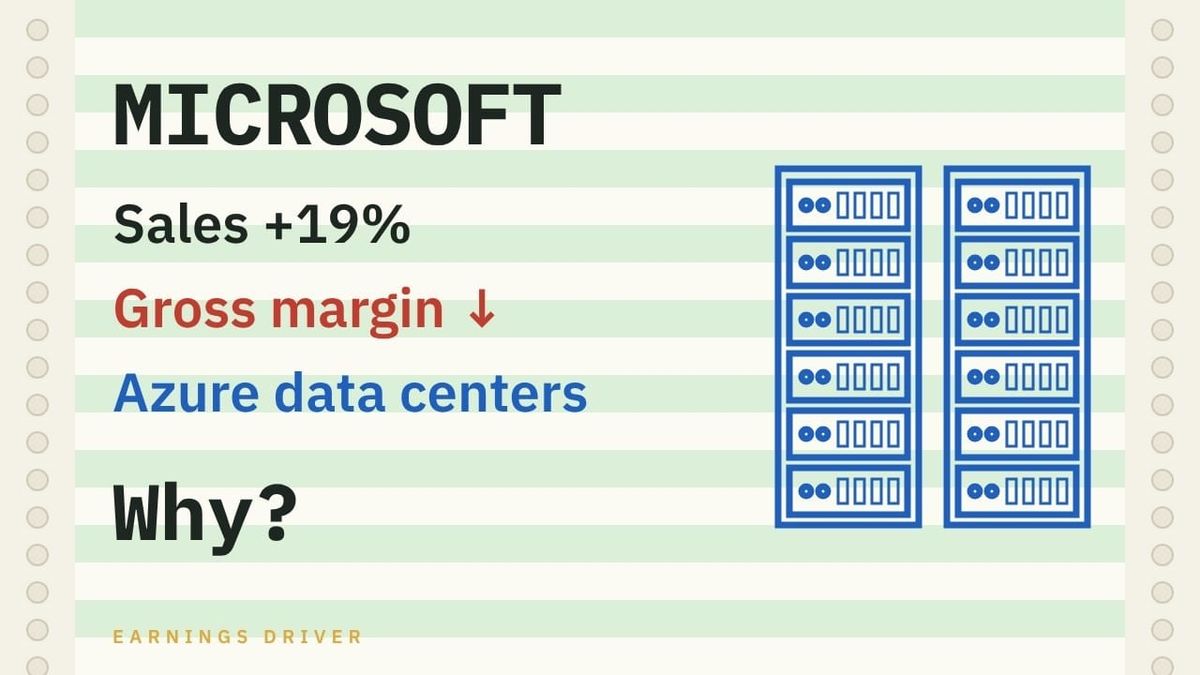
In one line: Microsoft earns from software it builds once and sells many times, and increasingly from Azure, which rents out computing power. Watch whether Azure revenue grows fast enough to pay for the data centers it needs.
At a glance
- Latest: in July–September 2026, Microsoft's cash from operations was $58.0 billion. Cash spent on property and equipment was $39.4 billion, twice the $19.4 billion of a year earlier. That left free cash flow of about $18.6 billion, down from about $25.7 billion.
- Biggest risk: Microsoft expects capital spending of about $170 billion in calendar 2026, which becomes depreciation cost over the following years. About 11% of its revenue in July–September 2026 came from OpenAI, the maker of ChatGPT.
- Reports: Quarterly. Next results: see Earnings Dates.
On October 28, 2026, Microsoft reported revenue of $92.3 billion for July–September 2026, up 19% from a year earlier. Azure, its cloud computing business, supplied 74% of that increase. Microsoft said customer demand for Azure still exceeds the computing capacity it can supply. In the same quarter, Microsoft's gross margin fell and the cash it spent on property and equipment doubled.
The latest quarter against expectations
| Reported | Expected | Gap | |
|---|---|---|---|
| Revenue, July–September 2026 | $92.3 billion | $90.6–90.7 billion | About 2% above |
| Earnings per share, non-GAAP | $4.89 | $4.71–4.73 | About 3–4% above |
| Revenue guidance, October–December 2026, midpoint | $96.6 billion | $95.6 billion | About 1% above |
Expected: consensus estimates compiled before the results by LSEG, FactSet and Zacks. Non-GAAP earnings per share exclude gains and losses from Microsoft's investment in OpenAI.
Azure revenue was $33.2 billion, against an expected $32.8 billion. Operating income rose 21% to $45.9 billion. Gains and losses from the OpenAI investment added $207 million to net income, against a $3.1 billion reduction a year earlier.
For October–December 2026, Microsoft guided revenue to $96.0–97.1 billion, up 18–19% from a year earlier. It expects Azure to grow 49–50% in constant currency. Chief financial officer Amy Hood expects cost of revenue to rise 26–27% and operating margin to dip slightly from a year earlier. She also expects revenue from Windows on new PCs and from Microsoft's devices to fall by around 35%.
What it sells vs. what it earns on
Microsoft reports eight product lines, and Azure has become the largest.
| Product line, July–September 2026 | Revenue | Share of total | Change from a year earlier |
|---|---|---|---|
| Azure | $33.2 billion | 36% | +48% |
| Microsoft 365 cloud (Office, Teams, Copilot, GitHub and related services) | $27.8 billion | 30% | +17% |
| Productivity and server licensing | $8.4 billion | 9% | −3% |
| Search and advertising | $6.6 billion | 7% | +10% |
| Xbox | $5.4 billion | 6% | −2% |
| Industry solutions | $5.3 billion | 6% | +9% |
| Windows OEM and devices | $3.6 billion | 4% | −22% |
| Frontier and support services | $2.1 billion | 2% | +4% |
| Total | $92.3 billion | 100% | +19% |
The steepest fall was in Windows OEM and devices. Windows OEM revenue comes from Windows sold preinstalled on new PCs. It fell because PC makers bought heavily a year earlier, when Windows 10 support ended. Microsoft also cited weaker PC demand, and said PC makers and resellers were using up stock they already held.
Microsoft groups these lines into two segments. Devices and Consumer holds Windows OEM and devices, Xbox, and search and advertising. Agents and Infra holds the rest: Azure, Microsoft 365 cloud, productivity and server licensing, industry solutions, and frontier and support services.
| Segment, July–September 2026 | Revenue | Operating income | Operating margin (a year earlier) |
|---|---|---|---|
| Agents and Infra | $76.8 billion | $40.6 billion | 52.8% (53.1%) |
| Devices and Consumer | $15.5 billion | $5.4 billion | 34.6% (32.8%) |
| Total | $92.3 billion | $45.9 billion | 49.8% (48.9%) |
Agents and Infra brought in 83% of revenue and 88% of operating income. Its operating margin slipped slightly, which Microsoft linked to the shift in sales toward Azure. Devices and Consumer's margin rose because the cost Microsoft books each quarter for the games and brands it acquired with Activision Blizzard fell.
The shift toward Azure shows most clearly in gross margin. Microsoft Cloud, which combines Azure, Microsoft 365 for businesses and industry cloud services, had revenue of $63.9 billion, up 30%. Company gross margin fell to 67.8% from 69.0% a year earlier. Cost of revenue rose 24%, faster than revenue, which Microsoft linked to investments in data centers for Azure and Microsoft 365. Microsoft Cloud gross margin fell to 66% from 68%, "driven by sales mix shift to Azure," Microsoft said.
A software license or subscription costs little to deliver once the product is built. Azure needs more servers, chips, buildings and power as customers use more of it. The depreciation of those servers and buildings and the power bill land in cost of revenue. So Azure keeps a smaller share of revenue as gross profit than software.
Company operating margin still rose, because spending on research, sales and overhead grew about 6%, far less than revenue. Microsoft's headcount was 2% lower than a year earlier. From July 2026, Microsoft depreciates data center buildings over 25 years instead of 15, though it said the effect on operating income would be minimal.
OpenAI stands out among Microsoft's customers. In July–September 2026, Microsoft earned $10.0 billion from its commercial arrangements with OpenAI, including revenue-sharing payments. That was about 11% of total revenue. Microsoft does not say which product lines that revenue falls in. In January 2026, Microsoft said about 45% of its contracted future revenue came from OpenAI.
What moves the profit
Operating income ≈ Azure revenue + Microsoft 365 commercial seats × revenue per seat + other product revenue − cost of revenue − research and development − sales, marketing and overhead
- Azure revenue. Fees for renting computing power, storage and AI models. Reported: quarterly, in the product revenue table of the Form 10-Q.
- Microsoft 365 commercial seats. Paid business users of Office, Teams, GitHub and related services. Reported: the growth rate, 5% from a year earlier, after 7% the year before. Microsoft 365 revenue from business customers, part of the Microsoft 365 cloud line, grew 17%, so average revenue per seat rose. Revenue per seat: not disclosed.
- Cost of revenue. Includes depreciation of servers and data center buildings. Reported: company total, and Microsoft Cloud gross margin. Azure's own margin: not disclosed.
- Capital spending. Not part of operating income. It enters cost of revenue later, as depreciation.
Microsoft guided capital spending to more than $50 billion for October–December 2026. That measure includes finance leases for rented data centers, and it was $45.2 billion in July–September. The calendar 2026 estimate moved from about $190 billion in April to about $175 billion in July. Microsoft said the July cut reflected accounting changes, such as moving some leases out of this measure, not less building. The October cut, to about $170 billion, came from delays at outside data center operators.
On September 30, 2026, leases signed but not yet started, mostly for data centers, totaled $364.6 billion. They begin between fiscal 2027 and fiscal 2034, with each fiscal year starting in July. Microsoft already carried $71.0 billion of finance lease liabilities on that date.
Reading the earnings: what to watch, and how
All five items are in the results release, the Form 10-Q or Microsoft's investor metrics page.
- Azure revenue growth
Read it: Growth below the range Microsoft guided for that quarter points to late capacity or weaker demand. Growth within or above it points to capacity arriving as planned.
Latest: 48%, which Hood called "ahead of expectations." Microsoft had guided about 45% in constant currency in July, and 49–50% for October–December 2026. - Microsoft Cloud gross margin
Read it: A fall while Azure grows fast points to the shift toward Azure, and a steady margin then means Azure's own margin is improving. A fall while Azure slows points to Azure's own margin falling, for example because new data centers cost more than they earn at first.
Latest: 66%, down from 68% a year earlier. Microsoft guided about 65% for October–December 2026. - Free cash flow
Read it: Free cash flow above zero means Microsoft is still paying for its data centers from its own cash.
Latest: About $18.6 billion, down from about $25.7 billion a year earlier. - Commercial remaining performance obligation
Read it: This is contracted revenue not yet counted as revenue, similar to a backlog. A rising total means customers signed more than Microsoft delivered, and a smaller share due within 12 months means more arrives later.
Latest: $677 billion, up 73% from a year earlier, with about 30% due within 12 months. - Revenue from OpenAI
Read it: Microsoft lists OpenAI as a related party in the notes to the Form 10-Q. A rising share means more of Microsoft's revenue would be at risk if OpenAI spent less.
Latest: About 11% of revenue in July–September 2026. OpenAI owed Microsoft $7.2 billion on September 30, 2026, and Microsoft owns about 24% of OpenAI.
What analysts are asking
Across Microsoft's last four earnings calls, from January to October 2026, analysts kept returning to a few questions, summarized here in our words.
- "Will the spending on data centers earn a return?" In July, Hood said her confidence in that return rests on a larger market for AI and on ways to cut costs. She named cheaper chips, including Microsoft's own, and a more efficient mix of models.
- "When will Azure capacity catch up with demand?" In October, Hood said some supply Microsoft had counted on for October–December had moved to January–June 2027. In April, she had said in her opening remarks that capacity would stay constrained at least through 2026.
- "How will AI work on Azure split between OpenAI, Microsoft's own models and others?" In October, chief executive Satya Nadella said customers would draw on several kinds of models for any workload. Coding customers, he said, want Anthropic and OpenAI "to compete for your workload."
- "How quickly will business customers shift from paying per seat to paying for AI by use?" In October, Nadella said that "on the coding side, it will be faster," because developers are used to paying as they go. Hood expected a slower shift outside coding.
- "Can operating margin stay near 50% as spending rises?" In October, Hood said the "best solution here is revenue growth," along with efficiency gains and control of operating expenses.
A note on valuation
Microsoft's share price closed at $531.01 on October 28, 2026, before the results. That was a price-to-earnings ratio of about 27.7 on GAAP earnings per share of $19.16 for the four quarters to September 2026. Those earnings include an OpenAI investment gain worth $1.02 per share in October–December 2025. On non-GAAP earnings per share of $18.04, the ratio was about 29.4.
The bottom line
In July–September 2026, Microsoft's gross margin fell as sales shifted toward Azure, its fastest-growing business, which needs buildings and chips paid for up front. Slower growth in other costs lifted operating margin anyway. The coming quarters will show whether Azure's sales keep pace with that up-front cost.
Why does software keep so much of its revenue after the product is delivered? In Earnings Driver, the chapter on Netflix and Adobe explains why software costs a great deal to build but almost nothing to copy.
Sources: Microsoft results release for July–September 2026 (October 28, 2026); Microsoft quarterly report on Form 10-Q for July–September 2026; Microsoft investor metrics for fiscal 2027 first quarter; Microsoft results release for October–December 2025; Microsoft earnings calls of January 28, April 29, July 29 and October 28, 2026; consensus estimates compiled before the results by LSEG (reported by CNBC), FactSet (reported by the Wall Street Journal), Zacks and Visible Alpha; share price from StockAnalysis.
For sources that work for any company — filings, earnings calendars, consensus estimates — see Where to find the numbers.
Educational only, not investment advice. Figures as of the periods noted.