Ajinomoto Sells Seasoning. A Quarter of Its Segment Profit Comes From a Film Inside Chips.
Ajinomoto earns most of its revenue from seasonings and foods, but about a quarter of its segment profit from Functional Materials. That business is built around Ajinomoto Build-up Film (ABF), the insulating film inside the substrates that AI and other high-end chips are mounted on.
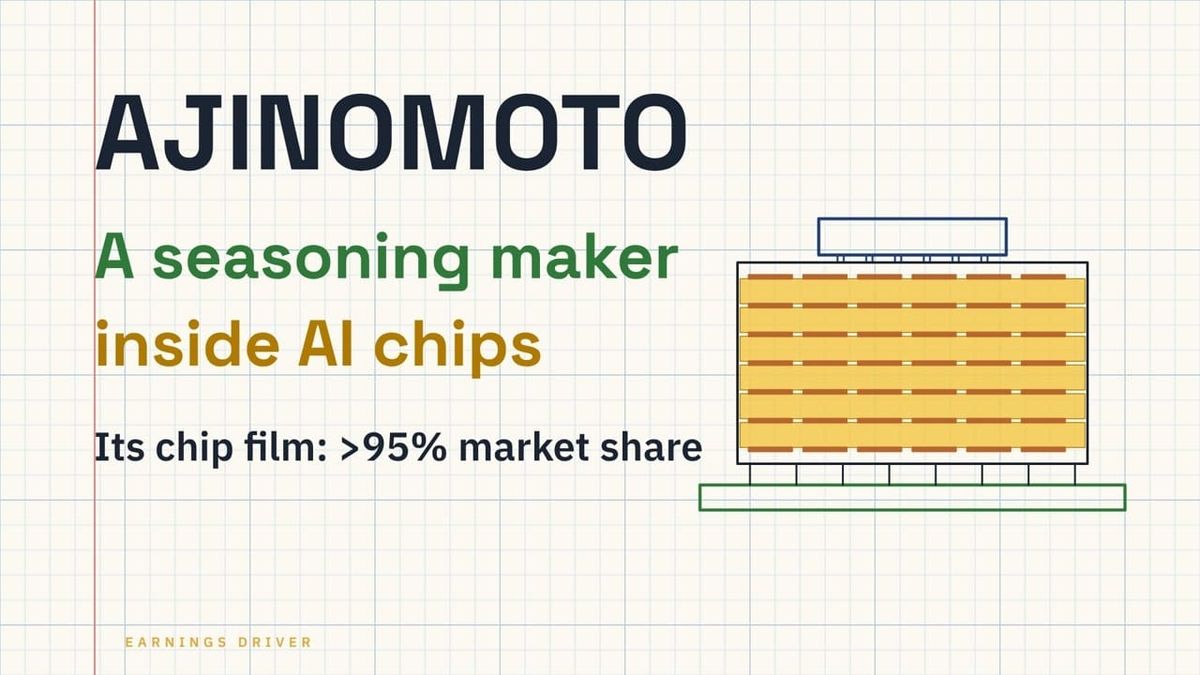
In one line: Ajinomoto earns most of its revenue from seasonings and foods, but about a quarter of its segment profit from Functional Materials. That business is built around Ajinomoto Build-up Film (ABF), the insulating film inside the substrates that AI and other high-end chips are mounted on. Watch whether Functional Materials sales in 2H (Oct 2026–Mar 2027) grow more than the roughly 7% from a year earlier that Ajinomoto forecasts.
At a glance
- Latest: Functional Materials sales up 63% from a year earlier in 1H (Apr–Sep 2026).
- Biggest risk: when chipmakers and substrate makers cut their inventories, orders for the film fall. In FY (Apr 2023–Mar 2024), Functional Materials sales and profit both fell.
- Reports: Quarterly. Ajinomoto's fiscal year (FY) runs from April to March. Next results: see Earnings Dates.
On November 9, 2026, Ajinomoto reported revenue of ¥831.2 billion (about US$5.21 billion, at Ajinomoto's average rate of about ¥159.5 to the dollar) for 1H (Apr–Sep 2026), up 12.5% from a year earlier. Business profit, Ajinomoto's main profit measure, rose 25.2% to ¥108.6 billion (about US$0.68 billion). It leaves out other operating income and expenses, such as gains on selling property. Sales of the Functional Materials business (electronic materials and others), which makes ABF, rose 63%, and its business profit rose 81%. Of the ¥21.8 billion rise in Ajinomoto's business profit, ¥19.3 billion came from that business.
Who Ajinomoto is
In 1907, Kikunae Ikeda, a chemistry professor in Tokyo, began studying the savory taste of broth made from kombu, a kelp. He traced the taste to glutamic acid, an amino acid, and called it umami. In 1908 he patented a way to make a seasoning from a salt of glutamic acid. Saburosuke Suzuki II agreed to make and sell the seasoning, AJI-NO-MOTO ("essence of taste"), and sales began on May 20, 1909.
From the 1970s, Ajinomoto studied uses for co-products of its seasoning production, including resins. In 1996, a maker of computer processors asked Ajinomoto to develop an insulating film based on Ajinomoto's amino acid technology. Ajinomoto launched ABF in 1999 and says ABF has a market share of more than 95%.
Today, Ajinomoto sells seasonings and packaged and frozen foods in many countries. It also makes amino acids for medicines and foods, electronic materials, and medicines for drug companies under contract (Bio-Pharma Services). ABF is made by a wholly owned subsidiary, Ajinomoto Fine-Techno, at sites in Kawasaki and in Gunma Prefecture, Japan.
The latest quarter against expectations
Table 1 — Ajinomoto's results and guidance against analysts' estimates
| Ajinomoto | Analysts' estimates | Compared with estimates | |
|---|---|---|---|
| Business profit, 1H (Apr–Sep 2026) | ¥108.6B | ¥109.8B | About 1% below |
| Revenue guidance, FY (Apr 2026–Mar 2027) | ¥1,767.0B | ¥1,740.9B | About 1.5% above |
| Net profit guidance, FY (Apr 2026–Mar 2027) | ¥135.0B | ¥138.4B | About 2.5% below |
The 1H estimate adds the 2Q (Jul–Sep 2026) consensus estimate reported by Investing.com on November 9, 2026 (¥49.7B) to the 1Q (Apr–Jun 2026) actual result (¥60.1B). The full-year estimates are the average of 14 analysts compiled by Minkabu on November 4, 2026. Net profit is profit attributable to Ajinomoto's shareholders.
Business profit for 1H was about 1% below analysts' estimates. Bio-Pharma Services earned less than a year earlier, partly because its US gene therapy maker, Forge Biologics, lost several large production batches.
Ajinomoto raised its forecast for business profit for FY (Apr 2026–Mar 2027) to ¥210.0 billion, from ¥202.0 billion in August. It added ¥11.0 billion for Functional Materials. It cut ¥3.0 billion from frozen foods, citing higher raw material and logistics costs overseas. Its net profit forecast rose from ¥123.5 billion but stays below analysts' estimates. On the November 9 call, an analyst asked why Functional Materials growth would slow from 63% to about 7% in 2H (Oct 2026–Mar 2027). Ajinomoto said it had no particular concern, called the forecast "almost like a commitment line" and said it had raised it each quarter.
What it sells vs. what it earns on
Functional Materials made up about 6% of Ajinomoto's revenue in FY (Apr 2025–Mar 2026), but earned more than three times the margin of seasonings and foods.
Table 2 — Ajinomoto's revenue and business profit by segment, FY (Apr 2025–Mar 2026)
| Revenue | Business profit | Margin | |
|---|---|---|---|
| Seasonings and foods | ¥936.9B | ¥143.0B | 15% |
| Frozen foods | ¥290.3B | ¥8.4B | 3% |
| Healthcare and others | ¥341.5B | ¥66.2B | 19% |
| of which Functional Materials | ¥100.7B | ¥54.6B | 54% |
| Other | ¥14.9B | ¥6.0B | 40% |
| Company-wide expenses | −¥42.5B | ||
| Ajinomoto | ¥1,583.7B | ¥181.1B | 11% |
Ajinomoto reports Functional Materials inside Healthcare and others, so its row is not added to the total. At about ¥151 to the dollar, the average of Ajinomoto's quarterly rates for FY (Apr 2025–Mar 2026), ¥100.7 billion is about US$0.67 billion. Sources: Ajinomoto's results presentation for FY (Apr 2025–Mar 2026); Ajinomoto's segment forecast of November 9, 2026, which also gives Functional Materials figures for FY (Apr 2025–Mar 2026).
A substrate is built from layers of copper wiring with insulating layers of ABF between them. As chips for servers have grown larger and more complex, substrates have grown larger and gained layers, so each chip needs more film. Ajinomoto's June 2026 briefing shows substrates with 3 layers of ABF in 1999 and 11 in 2026.
By quantity, servers and networks used 70% of the ABF Ajinomoto sold in FY (Apr 2025–Mar 2026), up from 40% in FY (Apr 2017–Mar 2018). Over a similar period, the Functional Materials margin rose from about 30% in FY (Apr 2018–Mar 2019) to 54% in FY (Apr 2025–Mar 2026).
Ajinomoto develops each grade of ABF with its customers for a new generation of chips. The price and the performance are set together during this development.
How much has price added to the margin? On May 15, 2026, Ajinomoto Fine-Techno denied a Digitimes report that it would raise ABF prices by 30% from 2Q (Jul–Sep 2026). In August, Ajinomoto said the higher margin in 1Q (Apr–Jun 2026) came mainly from selling more high-value grades. In November, Ajinomoto said it had not raised prices. It also said that when the same product is used many times, its price tends to fall.
Functional Materials sales have fallen before. In FY (Apr 2023–Mar 2024), chipmakers and substrate makers were cutting their inventories. Sales fell by more than 10% and business profit by about a quarter, according to a chart in Ajinomoto's factbook. The margin fell from about 52% to about 45%.
Ajinomoto Fine-Techno opened a new plant in Gunma in 2025. In November 2026, Ajinomoto decided to build another Gunma plant to raise ABF capacity. The new plant will make ABF varnish, the resin that is made into the film. It is planned to cost about ¥21.5 billion and start mass production in the year from April 2030. In May 2026, Ajinomoto Fine-Techno announced it would buy land in Gifu Prefecture for demand after 2030.
What moves the profit
Operating income ≈ Seasonings and foods profit + Frozen foods profit + ABF sold × (Price − Unit cost) − Electronic materials R&D and overhead + Other healthcare profit − Company-wide expenses
- Seasonings and foods, frozen foods, other healthcare: Business profit reported every quarter by segment.
- ABF sold: Not disclosed. The closest public figure is Functional Materials sales growth, which Ajinomoto gives every quarter and which also includes price and the mix of grades.
- Price and unit cost: Not disclosed. The mix of grades is reflected in the Functional Materials margin.
- Electronic materials R&D and overhead: Not disclosed separately.
Reading the earnings: what to watch, and how
Ajinomoto's results release, presentation and factbook are at ajinomoto.co.jp/company/en/ir/.
- Functional Materials sales growth.
Read it: faster growth means more ABF sold, more high-value grades, or higher prices. Growth slows when chipmakers and substrate makers cut their inventories.
Latest: up 63% from a year earlier in 1H (Apr–Sep 2026). Ajinomoto's forecast implies about 7% in 2H (Oct 2026–Mar 2027). - Functional Materials margin.
Read it: rises with more high-value grades, higher prices, or more sales over the same fixed costs. It falls when sales drop.
Latest: 58.5% in 1H (Apr–Sep 2026), against 52.6% a year earlier (our calculation from Ajinomoto's segment figures). - Seasonings and foods business profit.
Read it: the largest part of Ajinomoto's business profit. A fall here can offset ABF's growth.
Latest: ¥77.5 billion in 1H (Apr–Sep 2026), up 11% from a year earlier. - Costs from tensions in the Middle East.
Read it: higher oil prices raise the cost of fermentation raw materials, food ingredients, packaging, energy and transport. Profit falls unless higher prices and cost cuts cover these costs.
Latest: in November 2026, Ajinomoto estimated these costs could cut business profit for FY (Apr 2026–Mar 2027) by about ¥25 billion from its new forecast. It said it aims to absorb them within the year.
Leading indicators (outside Ajinomoto's filings)
- Monthly sales of Taiwanese substrate makers (Unimicron, Kinsus and Nan Ya PCB) — how busy the factories that buy ABF are. Unimicron also makes other circuit boards. (demand)
- When: by the 10th of each month, for the month before
- Where: Taiwan's Market Observation Post System (MOPS)
- Latest: Unimicron's revenue was NT$18.99 billion (about US$0.60 billion) in October 2026, up 68% from a year earlier.
What analysts are asking
Across Ajinomoto's last four earnings calls, from February to November 2026, analysts kept returning to a few questions, summarized here in our words.
- "How long can demand for ABF keep growing this fast?" In November, Ajinomoto said it expects "a continued strong growth of ABF from direct customers and also from the end users." Asked whether it expects ABF to grow faster than the market, it said, "Yes, that is our expectation."
- "Is Functional Materials growth coming from volume, price or the mix of grades?" In November, Ajinomoto said "the volume, mix, and price has all gone upwards." It said this did not include any price increase.
- "Why will seasonings and foods earn less in 2H (Oct 2026–Mar 2027) than a year earlier?" In November, Ajinomoto said it will spend more on sales promotion, and that "there is a time lag in terms of when the effect of the price increase is going to come out."
- "Can frozen foods earn more than its cost of capital?" In November, Ajinomoto said that a return on invested capital below the cost of capital "is not permissible." Ajinomoto did not give a deadline.
- "How much more ABF can Ajinomoto make before the new plant opens in 2030?" In November, Ajinomoto said, "The specific production capacity we have not disclosed." It said adding work shifts would raise output, though not in proportion to the number of shifts.
A note on valuation
Ajinomoto's share price closed at ¥4,430 on November 9, 2026. The company released its results after the market closed that day. The closing price was a price-to-earnings ratio of about 27 on earnings per share of ¥162.97 for the four quarters to September 2026. Those earnings include a ¥40.6 billion gain before tax on selling the land and building of Ajinomoto's head office in 4Q (Jan–Mar 2026). They also include a tax benefit in 1H (Apr–Sep 2026) linked to the planned merger of Ajinomoto Fine-Techno into Ajinomoto in April 2027. Without these items, the ratio would be higher.
The bottom line
Seasonings and foods earn Ajinomoto the largest share of business profit. But in 1H (Apr–Sep 2026), most of its profit growth came from Functional Materials. Ajinomoto's forecast has that business growing far more slowly in 2H (Oct 2026–Mar 2027), though the company has raised its full-year forecast for the business each quarter. Ajinomoto says the business grew through volume and higher-value grades, not price increases.
How long can a supplier that customers cannot easily replace keep its earnings? Chapter 35 of Earnings Driver looks at suppliers that chipmakers and other industries cannot easily replace, and at why they must keep developing materials for products not yet designed: "The earnings are real, but they must be re-earned every generation."
Sources: Ajinomoto results release, presentation and segment forecast for 1H (Apr–Sep 2026), released November 9, 2026; Ajinomoto results presentations (May 7 and August 6, 2026) and factbook 2026; Ajinomoto Fine-Techno, "Growth Strategy for the Electronic Materials Business" (June 30, 2026) and statement of May 15, 2026; Ajinomoto Group history; Ajinomoto earnings calls of February 5, May 7, August 6 and November 9, 2026 (transcripts, Investing.com); Digitimes (May 13, 2026); analysts' estimates from Investing.com (November 9, 2026) and Minkabu (November 4, 2026); Unimicron monthly revenue for October 2026 (TechNews, November 6, 2026); share price as of November 9, 2026.
For sources that work for any company — filings, earnings calendars, consensus estimates — see Where to find the numbers.
Educational only, not investment advice. Figures as of the periods noted.